
Even though the whole world talks about the war in Ukraine, not many people know this conflict’s background. Not because they would be stupid – war in Ukraine is actually pretty simple – but because it takes time to understand it. Some poeple don’t have this time. And then other people try to take advantage of them: spreading misleading or even purposely false information.
The following article therefore summarizes all important moments in Ukrainian history relevant to the current war. Yeah, it’s long, but we tried – after all, we’re talking about more than a thousand years of development… We also didn’t want to leave out any important information. Putin and Russian propaganda often justify the war in Ukraine by selecting only what suits them from Ukrainian history – it’s hard to detect if you don’t have the whole picture – so here it is 😉
Kievan Rus’: How it All Began
The story begins in the 9th century with Kievan Rus’, the first state formation of Slavs (before there were only tribes). Covering parts of modern-day Ukraine, Russia, and Belarus. Because Kievan Rus’ was very big, its ruler Vladimir the Great divided it into smaller principalities between his sons:
- principalities Pereyaslav, Chernihiv, Volyn were in the territory of current Ukraine
- Polotsk was in nowadays Belarus
- Smolensk, Novgorod, Rostov-Suzdal in current Russia
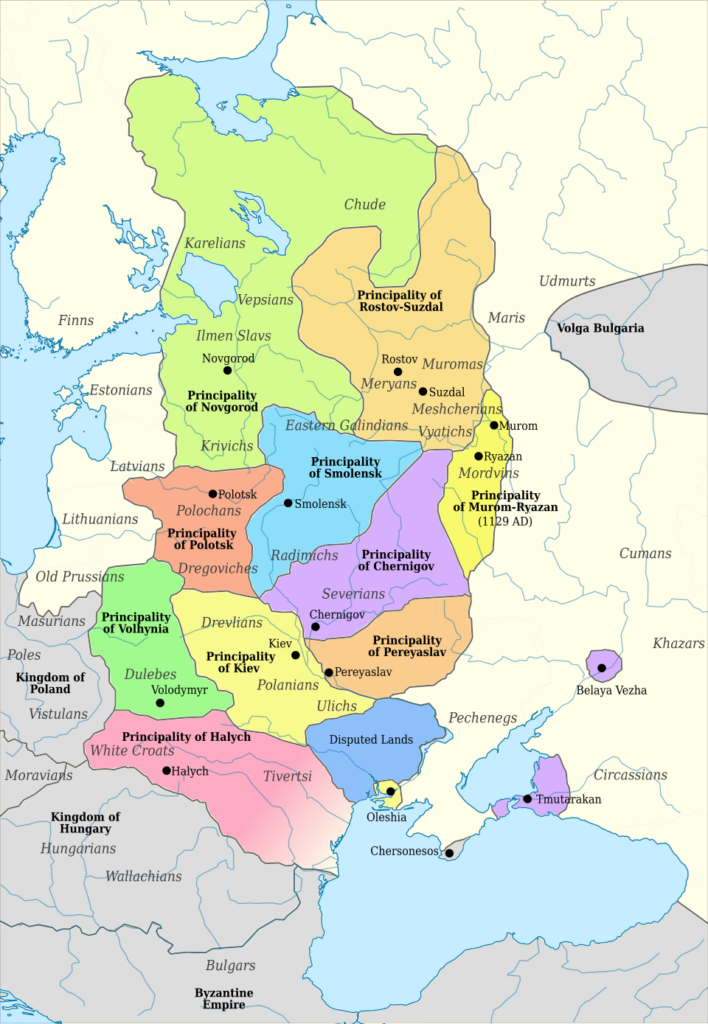
But Kievan Rus’ never controlled all of modern Ukraine. The southern steppe dominated Turkic tribes – the Pechenegs and Cumans – who were constantly in conflict with Kievan Rus’ (everyone was constantly in a conflict in this time period).
In the 13th century, Mongolian Empire invaded Kievan Rus’. It was more precisely one sector of Mongolian Empire called the Golden Horde. Kievan Rus’ fell apart. Its successor states were Kingdom of Galicia-Volhynia, Novgorod Republic and Vladimir-Suzdal.

Ukraine between Poland, Moscow, and the Crimean Khanate
Kingdom of Galicia and Volhynia was later divided between Poland and Latvia. Those countries were in their prime at that time, and later they formed a Polish-Lithuanian Union.
Novgorod Republic and Vladimir-Suzdal were located in a territory of nowadays Russia, and Vladimir-Suzdal later transformed into Principality of Moscow, which is ancestor to nowadays Russia.
In the 15th century, the Golden Horde transformed into the Crimean Khanate, a vessel of the Ottoman Empire. The word vessel can be a little bit confusing: it might feel like a synonym for friend or partner… But keep in mind, at this time of history, all states were competitors trying to secure their own safety, and get as much power as possible – event those three states on the territory of Ukraine: Polish-Lithuanian Union, Principality of Moscow, and Crimean Khanate
Cossacks
Into this dynamics emerged Cossacks. Semi-independent, combative groups with uncertain ethnic origin, which started to settle around the Dnipro river in the 16th century. Basically at a meeting point of our three states (Polish-Lithuanian Union, Moscow Principality, and Crimean Khanate)
The combativeness of Cossacks was making them hard to conquer, and at the same time – in the eyes of Poland and Crimean Khanate – an ideal army: if they paid them enough money, they would go fight anyone.
In the 17th century, Cossack leader Bohdan Khmelnytskyi, sought to renew Kievan Rus’. To accomplish that, he allied with the Crimean Khanate. At first they were winning – Cossacks even managed to form their state: so-called Hetmanate (name derived from “hetman”, the leader of the Cossacks). But after some time, the Crimean Khanate got scared by the power Cossacks were gaining and betrayed them. Cossacks had to search for a new ally. Out of all possibilities, Khmelnytskyi resorted to Moscow.
He had to – nothing else worked out. This 1654 Pereyaslav Agreement between Cossacks and Moscow was very unequal. Cossacks had to accept the sovereignty of the Tsar. Hetmanate, which was pretty much the majority of nowadays Ukraine, fell under the full control of Russia.
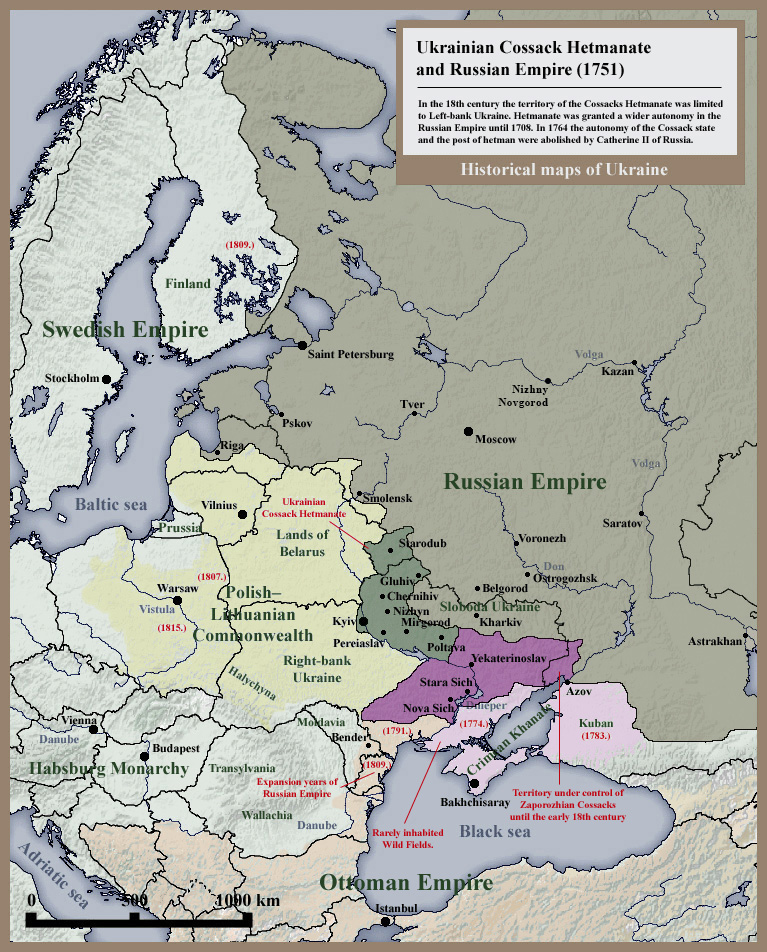
After Khmelnytskyi died, his successors tried to get Hetmanate out of the Russian influence – without any success. Since Poland was also making territorial claims, Ukraine was split along the Dnieper River: the west went to Poland, the east stayed with Russia.
In the 18th despite its big size, Poland lost its power and neighboring countries Prussia, Russia and the Habsburg monarch decided to use this opportunity and divided Poland between themselves. (It’s called “three partitions of Poland”). This meant the Russian sphere of influence moved more to the west and the only part of nowadays Ukraine left out was Galicia, now belonging to the Habsburg monarchy.
Neither Habsburg monarchy nor Russia were ideal for Ukrainians to live in. They were both trying to suppress their national identity. Russia maybe a bit more, since they were trying to claim Ukrainian language is just a branch of Russian language. The German-speaking Habsburg monarchy obviously couldn’t use this argument.
When Russians are nowadays making territorial claims about Ukraine, this historical period is one of their arguments. Another one is Crimea.
A Glimpse into Crimea
While Ukraine’s heartland was divided between Poland and Russia, Crimea followed its own path. Originally ruled by the Crimean Khanate, a vassal of the Ottoman Empire, it fell to Catherine the Great in the 18th century after Russia won in the war against the Ottomans. Crimea stayed under Russia until 1954.
As all parts of the Soviet Union, Crimea underwent strong Russification. It was the worst under Stalin, who tried to get rid of Crimea’s indigenous population, Crimean Tatars, by deporting them to gulags.
In 1954, Soviet leader Nikita Khrushchev donated Crimea to Ukraine. At that time it was a symbolic gesture with little practical impact, since both were part of the USSR. However it started to be problematic after the fall of the Soviet Union.
After the fall of the Soviet Union, there were some attempts to make Crimea independent. Historically and ethnically, Crimean Tatars truly don’t have much in common – neither with Russia, nor with Ukraine. They are a Turkic ethnic group, with a language from Turkic languages family, and their predominant religion is Islam. Plus until the 18th century they had their own country: Crimean Khanate. So, in an ideal world, independence would be the most logical and fair solution for them.
But in the real world, the second Crimea tried to gain a little more independence after the fall of the USSR, Russia, motivated by Crimea’s strategic position with access to the sea, immediately tried to install its people there… The majority of Crimean Tatars realized this. When Ukraine reacted by abolishing the Crimean constitution, making Crimea more dependent on itself, they didn’t really protest. They still remembered how Stalin tried to eliminate their identity in Soviet times.
At this time even Russia accepted that Crimea would stay within Ukraine but autonomous. This confirmed the Russian-Ukrainian friendship treaty signed in 1997.

Budapest Memorandum
Talking about treaties, we have to mention the Budapest memorandum from 1994 in which Ukraine, Kazakhstan and Belarus promised to get rid of nuclear weapons and countries Russia, USA and UK promised to them to never use threatening military force or economic coercion against them.
The situation in Crimea was relatively calm until 2006, when Ukraine began considering NATO membership and planned a military exercise with NATO in Crimea. Some Crimeans who opposed Western influence and preferred closer ties with Russia protested this move. So did Russia who saw it as a violation to the Budapest memorandum.
This – along with claims about alleged secret US military bases in Ukraine, became another argument that Putin and his supporters use to justify the invasion. However, the Budapest Memorandum never banned military cooperation. It prohibited threats or use of force against Ukraine, not its right to partner with other nations. Also, Ukraine is an independent country, meaning that no other country has anything to say about with whom it cooperates or what structures it is joining. If someone was forcing Ukraine to join NATO, it would be a completely different story… But so far the only one who’s forcing Ukraine to do something that it doesn’t want is Russia.
In 2008, after the Russian invasion and war in Georgia, Russia started to give its passports to pro-Russian Crimeans. And Russian influence slowly started spreading: in language as people were speaking Russian, in education as there were pro-Russian professors in schools, Russians were going on vacation to Crimea… Whenever Ukrainians or Crimean Tatars were celebrating some Ukrainian holidays, pro-Russian people would mock them, firstly just by laughing, but then it started to be more and more violent…
But we’ll get into that… Now, let’s go back to where we left off: with Ukraine divided between the Habsburg Monarchy and Russia.
First world war
The first world war put Ukrainians into a very weird position. Since the Habsburg monarchy and Russia were enemies, Ukrainians living in the Habsburg monarchy had to fight against Ukrainians living in Russia.
During the war, the 1917 revolution happened in Russia. It weakened Russia and diverted its attention from Ukraine, who used this chance to declare the Ukrainian People’s Republic. Since the Central Powers (= WW1 alliance of Germany, Austria-Hungary, Bulgaria and the Ottoman Empire) were still doing well at that time, Ukraine used this as an opportunity to get officially recognized by signing a peace treaty with Central Powers.
For Ukraine this was kinda like national revival – even though they got under the influence of Germany, they could still do their thing. No one was banning the use of Ukrainian language or literature. But it all ended when Germany lost.
Between the wars
After Germany lost, no one wanted to recognize Ukrainian People’s Republic. Poland (which after the war gained its independence again) had still its eye on Ukraine and wanted it back. And because Poland had a good lobby in France, this got through. Ukraine ended up divided between Poland and Russia, plus some smaller parts went to Hungary and to then Czechoslovakia.
Ukrainian Soviet Socialist Republic
The biggest part of Ukraine ended up in Russia as the Ukrainian Soviet Socialist Republic. At the beginning the situation wasn’t that bad – at least concerning Ukrainian language. Soviet leader Lenin, wasn’t trying to ban the Ukrainian language, but instead promote it. This was a part of his so-called “korenizatsiia”’(= nativization) policy, which consisted of spreading communist ideology among people from different parts of the Soviet Union in their native languages and by their compatriots. Thanks to this people got the impression that communism was coming “from below” and from their country, and not being forced upon them from Moscow.
When Stalin got in power, he did the exact opposite: suppressing all sparks of nationalism, killing people even from his own circles. In Ukraine he even caused Holodomor (= famine), the greatest historical tragedy for Ukrainian people. Some historians believe that Holodomor was ethnic cleansing of Ukrainians. Although there is not a 100 % agreement on it among them.
Ukraine as a part of Poland
The part of Ukraine that went to Poland after the first world war was supposed to have some autonomy. The Polish government should guarantee it. But it didn’t. World powers had to force Poland to give Ukrainians some autonomy. Even though Poland didn’t authorize Ukrainian universities, they auhorized Ukrainian language and literature was and Ukrainian political parties.
Stepan Bandera and Organization of Ukrainian Nationalists
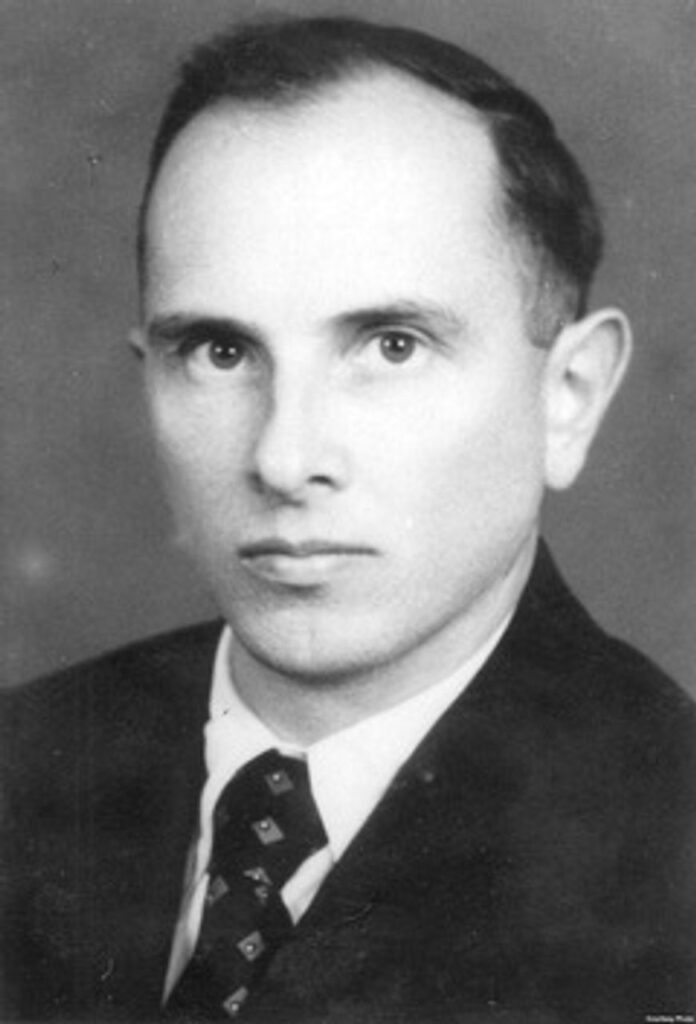
One of Ukrainian political parties that emerged in the “polish” part of Ukraine was the Organization of Ukrainian Nationalists (OUN) represented by the infamous Stepan Bandera. The main character of many Russian arguments for justifying the invasion of Ukraine… Unlike other Ukrainian parties this one was illegal. Mainly because the means they were using: sabotages or assassinations of the Polish governors. For example Bandera killed the Polish minister of home affairs and ended up in prison for it. Both Poland and the USSR feared the OUN, Soviets even organized an assassination attempt on one of its leaders.
Second World war
On the 1st September 1939 Germany attacked Poland. And because they had a secret Molotov-Ribbentrop pact with Russia, the Russians soon attacked Poland too. Poland was then divided once again. This time all Ukraine ended up under Russia – even the part with the 0rganization of Ukrainian Nationalists and Bandera. At this moment Bandera was released from prison.
But soon Germany backstabbed Russia too and attacked them, gaining Ukraine under their influence. Ukrainians, still remembering how Germany let them have their own country during the WW1, expected the situation would repeat and started to welcome Nazis.
This is the beginning of another problematic historical period which makes some people justify the Russian invasion of Ukraine. According to their logic, all Ukrainians are Nazis, because they cooperated with Germany during the Second World War. However, according to the same logic, the inhabitants of ALL states that cooperated with Germany in WW2 could be labeled as Nazis. This would include not only countries like Italy, Japan, or Slovakia, but also Russia. Because what else but collaboration was their Molotov-Ribbentrop pact with Germany?
Ukrainians however quickly learned that trying to be friends with Nazis wasn’t a good idea. When Bandera tried to declare independent Ukraine, Nazis put him in a concentration camp. Pretty ironic, isn’t it?
After this Bandera’s people formed the Ukrainian Insurgent Army (UPA) that started to fight everyone: especially Nazis but also all non-Ukrainians living in Ukraine – at that time mainly Polish people. Since Poland occupied Ukraine for a long time and wasn’t always nice to Ukrainians, they were now taking revenge. The Ukrainian insurgent army also fought against the red army, slowly moving to Ukraine.
Even after the war ended and the whole Ukraine was under the Soviet Union, the Ukrainian Insurgent Army didn’t stop fighting. They were trying to shoot their way to the west to meet the American army. They hoped that if they presented to Americans the plan of independent Ukraine they would recognize them which obviously didn’t happen – Ukraine ended up as a part of the Soviet Union. And it lasted like this until its fall in 1991.

Mentality switch after the fall of the Soviet Union
After the fall of the Soviet Union came the inevitable reality check. People are always idealizing freedom and it was the case even in the eastern bloc. They thought the grass is greener in the west and by simply declaring their independence they are going to get rich, have nice cars, televisions, clothes… But these things take time and they don’t arrive only because you are an independent country. You have to make an effort.
Your country also can’t play by its own rules anymore. As a democracy it’s a part of a bigger system, and has to be open to dialogue with others.
Moreover, people struggled with their identity. The Soviet Union lasted almost for 70 years – many people have never experienced anything else. And now it ended. It’s hard to find your place in a new world. Especially as a Russian. When the USSR collapsed, for other former Soviet countries it was a positive change – they gained independence from Russia. But Russia, who used to be a huge and powerful player, and now lost it all, naturally saw it as a tragedy. This helped people like Putin to get into power.
Putin’s rise to power
Putin got to power in the 90s. His recipe for success was giving people what they need: identity, economic development and what feels familiar to them.
- Identity: by creating a common enemy out of Chechens, during a war in Chechnya. Because nothing unites people more as having a common enemy and common fear out of something
- Economic development: caused by Russia’s huge national resources, especially oil and gas. This was pure luck. Putin simply happened to be in power in times when oil and gas started to be way more important than they were ever before
- And what feels familiar to them: by slowly returning back to the soviet style of government: suppressing free speech, putting his people in governing positions, changing the system of government from democratical to less democratical…
Sadly, western countries at that time didn’t connect the dots. They saw Putin as a strong leader who sometimes might be controversial but that’s just what strong leaders do, right? After all, he was still playing on his field…
Destabilize and rule
Even when Putin started armed conflicts in other countries (like for example in Georgia in 2008), it still didn’t raise much attention. Those countries were not relevant for western politicians. They still percieved them as part of the Soviet Union and believed those conflicts wouldn’t grow into something bigger that would concern them.
If you look at Putin’s involvement in Georgia, Crimea, Donbass, Syria, Nagorno-Karabakh or Transnistria you start to notice the pattern : Putin never gets involved in those countries to gain full control over them. It’s always just to destabilize them the moment they start to get stable, democratic or are approaching the west. The same thing happened to Ukraine.
From Orange Revolution to annexation of Crimea
We left Ukraine after the fall of the Soviet Union, when the first reality check came in. For a long time the situation didn’t get much better. The first two Ukrainian presidents, Leonid Kravchuk, and Leonid Kuchma, never succeeded to do needed economical reforms. There was corruption, and oligarchy (Leonid Kuchma even had killed the opposition journalist Gongadze)
Orange revolution
The 2004 presidential election pits pro-European Viktor Yushchenko against pro-Russian Viktor Yanukovych. Even though Yushchenko was poisoned before the elections (likely by Yanukovych), he survived and won. But the results were tight. So Yanukovych pushed for the second round. This time Yanukovych won. The elections were widely believed to be rigged. This triggered a wave of protests – called the Orange Revolution. The revolution took its name from the color of Viktor Yushchenko’s political party, “Our Ukraine,” which he led alongside Yulia Tymoshenko.
After mass protests, Yushchenko ultimately won the presidency. But the victory was hard-fought. Viktor Yanukovych still had strong support. And the joy of victory didn’t last long for Yushchenko…
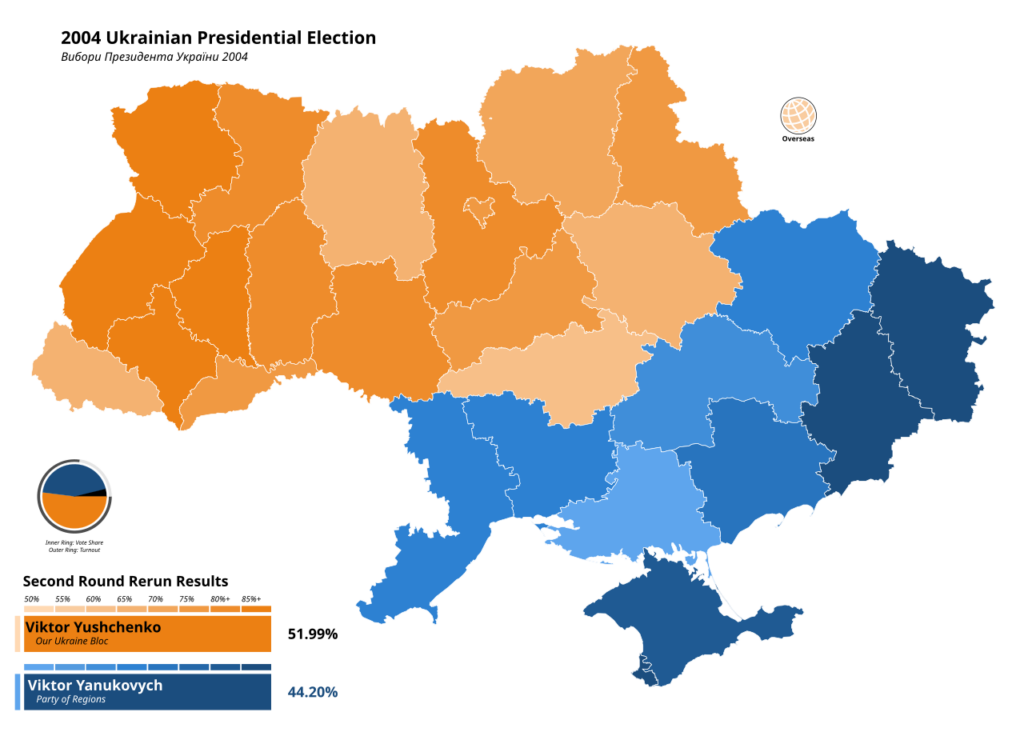
Soon he parted on very bad terms with Yulia Tymoshenko. Since Yushchenko was the president and Yulia Tymoshenko prime minister, it was a big problem. To achieve any change, the president and the prime minister must cooperate. However, these two were constantly fighting and sabotaging each other. They accomplished nothing and discredited themselves in the eyes of their voters.
This opened the path for Yanukovych to win the 2006 parliamentary elections. Also, in 2006 the new constitution entered into force. It was Leonid Kuchma, who had pushed through the constitutional reform in his final days to weaken his successor’s power. Before the Ukrainian president could choose the prime minister. Now the parliament was choosing – so of course they chose Yanukovych.
Yushchenko, stuck with a pro-Russian rival as his prime minister, tried to force new elections. This time, Tymoshenko won – so not only he didn’t help himself at all, he also seriously undermined the belief people formerly had in him. It’s no surprise that in 2010 it was Yanukovych who won the presidential election.
Euromaidan: Will Ukraine make it to the European Union?
Yanukovych got rid of Tymoshenko by putting her in jail and started to maximize his power through the constitution. Unlike Yushchenko, he could choose a prime minister who would act in his favor (btw this prime minister was of Russian origin). In 2013, the Eastern Partnership became a priority in the European Union. The chances were that Ukraine could sign an association treaty with the European Union. First Yanukovych liked this idea – not because he was pro-European but because he saw the money that would come out of it.
But Putin, who already had great influence over Yanukovych at that time, didn’t like this idea at all. He first put an embargo on Ukraine and invited Yanukovych to Moscow to make him change his mind and to force him not to sign the association treaty.
Of course society wasn’t blind. In November 2013 a series of protests – later called Euromaidan – started. In November 2013 Yanukovych was supposed to sign the association treaty at the summit of Eastern Partnership in Vilnius. Instead he left the summit last minute without signing.
After this, protesters on Maidan started to demand either signing the association treaty or demission of the government. Yanukovych’s response was strengthening economic ties between Russia and Ukraine by signing new treaties with Putin, and using violence on protesters. Action provokes the reaction, so even protesters started to be more violent.
Not only pro-Maidaners demonstrated. Members of the right sector (who do not miss any opportunity for aggression) also appeared and unfortunately got bigger media attention then they deserved. Russia remarked that and started to label all protesters as Nazis.
Sympathizers of Yanukovych also protested. Their demonstrations called anti-Maidans were happening mainly in eastern regions where Russian influence was always bigger than in the rest of Ukraine.
Russian annexation of Crimea
In February 2014 Ukrainian parliament finally had enough and removed Yanukovych from the post of president. Yanukovych fled to Russia immediately. Approximately one week later, on 27th of February, unmarked soldiers occupied strategic buildings in eastern Ukraine (Donetsk and Lugansk) and Crimea. Anti-maidaners were welcoming them and helping them. Whereas pro-maidaners and Crimean Tatars were trying to resist. Shortly after this occupation a suspicious referendum was held in which the majority of people in Crimea voted for the enactment of Crimea to the Russian Federation. This referendum was most likely rigged and no relevant country accepted its results.

Beginning of the War in Ukraine
After the annexation of Crimea, protests broke down all over the country, but mainly in the eastern parts of Ukraine.
Trade Unions House fire in Odessa
On May 2nd, at that time daily clashes between pro-Russian separatists and pro-Maidaners in Odessa escalated into a tragic event.
The usual parade before the football match turned into a pro-Maidan protest. But not only pro-Maidaners showed up – so did right sector people. This protest-parade was then attacked by anti-Maidaners. A fight broke out and one member of the right sector, Igor Ivanov died.
After this things got even more violent. Right sector protesters and pro-Maidaners attacked the camp of anti-Maidaners situated in front of the trade union house. Anti-Maidaners hid in the building. Both sides then started to use Molotov cocktails. It’s not known who started it, since each side claims it wasn’t them. As a result the building started to burn and 42 anti-Maidaners hiding inside died.
This tragedy often serves to justify the violence Russia is doing now in Ukraine. And even though pro-Maidaners weren’t all innocent in this massacre (although some of them tried to help, some of them on the other hand continued attacking anti-Maidaners after they managed to escape the building), brutality was coming from both camps.
Until this day, this incident remains surrounded by many shady details and still wasn’t investigated properly. For example, during that day police in Odessa did nothing to break down these protests. And even firefighters arrived very late to the site. And the chief of the police, and the head of emergency services of Odessa both fled Ukraine to Russia and later obtained Russian citizenship…
War in Donetsk and Luhansk
Shortly after the annexation of Crimea, unmarked soldiers also ceased strategic building in Donetsk and Luhansk, and declared Donetsk Republic and Luhansk Republic. Ukraine launched a military counter-offensive. After a few months, Russia sent their troops officially there, so a war started.
In September 2014, the first peace agreement arrived: the First Minsk Agreement. Also something Russia is using to justify the invasion. This Minsk Agreement is an attempt of immediate ceasefire in Ukraine. Its most important points are:
- withdrawal of all foreign (a.k.a. Russian) troops from Ukrainian territories
- guarantee of special status to Donetsk and Luhansk by Ukraine
- observation mission of the Organization for Security and Cooperation in Europe to those regions
- guarantee for local pro-Russian separatists who were helping Russian invasion, that they wouldn’t be persecuted
Since this agreement was constantly violated by both parties, in spring 2015, there was a Second Minsk Agreement. But even that wasn’t a solution. Even though the biggest clashes stopped, smaller conflicts continued happening. Both sides violated the agreement for years, and the conflict was slowly more and more escalating.
Could We Have Predicted the War in Ukraine?
To those who weren’t really interested in Ukraine or Russia, 2022 war in Ukraine may have come as a surprise. But actually, the war was going on since 2014. The 24th of February 2022, was just a big escalation.
It’s believed that Putin has been preparing for the war since January 2020. Originally he may have planned to launch the full-scale invasion already in 2021 (since in spring 2021 large amount of Russian troops were spotted near Ukrainian borders), but he probably decided to postpone because of covid.
In June 2021, there was a summit between Putin and Biden, where Putin declared very unrealistic expectations – basically giving an ultimatum, saying that Ukraine must commit to never join NATO, and that NATO must reduce its presence in Poland, Baltic states, and Eastern European countries. He repeated this ultimatum again in December 2021.
But all that time Putin knew that what he’s asking wasn’t realistic. He would have been completely delusional to think NATO and the US would accept those conditions. So the real question is WHY? Why did he give an ultimatum when he knew it’s not going to be accepted and he would have to go to war?