
US & Israel Attack on Iran : Story of the Last Week
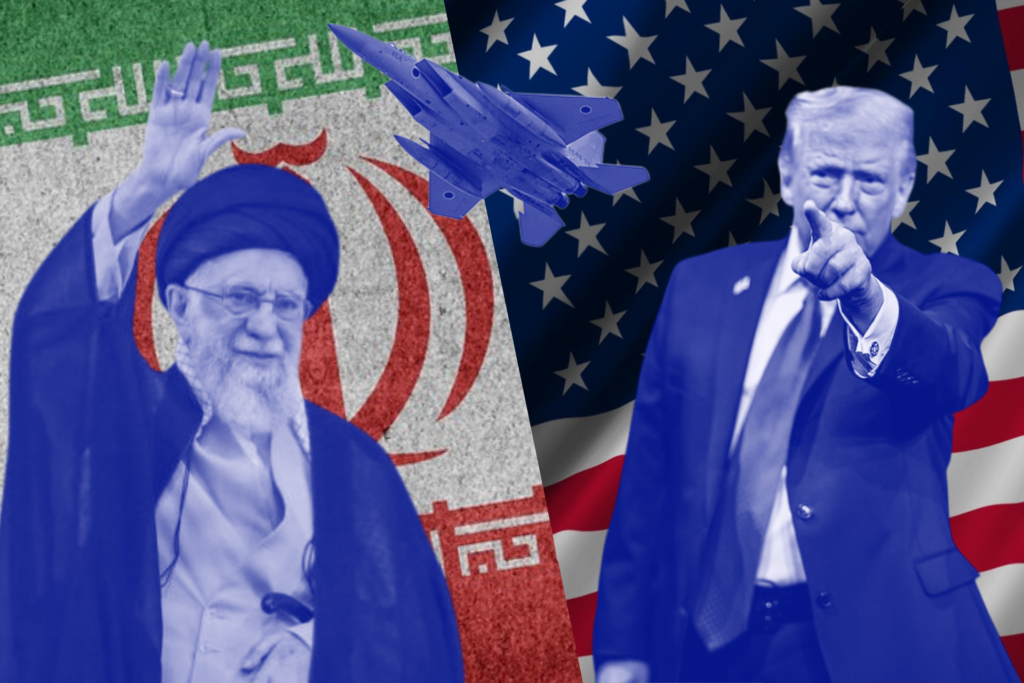
In the morning hours of 28th February, Israel and the United States “preventively” attacked Iran. They mainly bombed government buildings, however, the Iranian government claims that they also bombed civilian targets. During the attack, Iranian Supreme Leader Ali Khamenei, was killed. Ali Khamenei brutally ruled the country since 1983, having the blood of tens of thousands of Iranian people on his hands. One would expect that the Iranian undemocratic regime was the main reason for the intervention… However, the United States and Israel justify their “preventive” attack by fearing that Iran was expanding its nuclear program. Note that both the US and Israel have their own nuclear programs – Israel even undeclared (similarly like Iran). Iranian Nuclear Programme Iran started to develop its nuclear program in the 50s. During the reign of Shah Mohammad Reza Pahlavi, who wanted to turn Iran into a modern, Western-style superpower. The Iranian nuclear program was on of the ways to achieve his goal. Shah worked on it with the United States as part of the “Atoms for Peace” program. A nuclear program for non-war purposes – so basically nuclear power plants. Attention: When a country has a “nuclear program”, it doesn’t always mean they produce nuclear weapons. Nuclear program means even an ordinary nuclear power plant. However, if a country has a nuclear power plant, it’s theoretically able to produce nuclear weapons since the technology is similar. After the Islamic Revolution of 1979, the situation reversed. The Supreme Leader Ruhollah Khomeini completely stopped the Iranian nuclear program, saying that it was “against Islamic values”. But in the 80s, the Iranian government realized that if they wanted to be energy independent and able to scare-off neighboring countries (such as Iraq, which attacked them in the 80s), they simply needed the program… So they revived it again. Except this time Iran did not cooperate on it with the West, but with the Soviet Union, Pakistan and China. Officially, this nuclear program was only for “peaceful purposes”. But if you started digging deeper into it, you would discover that the program was suspiciously big. Given that Iran had only one nuclear power plant – for example: It was all revealed in 2002 during an IAEA (= International Atomic Energy Agency) inspection. Attempts followed to pressure Iran to limit its nuclear program. In 2003, Iran voluntarily signed and implemented the Additional Protocol to the Nuclear Non-Proliferation Treaty. The Nuclear Non-Proliferation Treaty (NPT) is an international agreement signed in 1968 where countries possessing nuclear weapons (= United States, Russia, United Kingdom, France and China) promised not to use them or spread them to other countries, and eventually get rid of them completely. And the non-nuclear countries agreed to never try acquiring nuclear weapons. In return, the five nuclear countries promised to help them with a peaceful nuclear program (such as the Atoms for Peace). In this Additional Protocol of NPT Iran agreed to permit more intensive IAEA inspections. But after two years it abandoned it. As a response Western countries imposed sanctions on Iran. After very difficult negotiations, in 2015 then-US president Barack Obama managed to negotiate a Joint Comprehensive Plan of Action (JCOPA) with Iran. In this agreement Iran promised to limit its nuclear program for the next 15 years in exchange for the lifting of sanctions. In addition to the USA and Iran, the agreement was signed by 6 other powers, including China and Russia. But then one American president canceled it… Surprise surprise, it was no one else than Donald Trump during his first presidency in 2018. Also, he imposed sanctions not only on Iran but also on European states if they wanted to trade with Iran. Since then, Iran has been moving closer to a nuclear weapon faster than before. Could We Have Predicted the Attack on Iran ? In July 2025, Israel attacked Iran, waging the so-called Twelve-Day War, which the United States later joined. It was an escalation of long-lasting rivalry between the two countries. Both had been indirectly attacking each other for a long time – this was their first direct clash. Basically: Israel is a western ally in the Middle East who “guards”, that local states – which happened to emerge in territories rich in now highly valued oil and which also share the same religion – from forming another global power that could challenge Western hegemony. In return, the West helps Israel maintain its position in the Middle East. So that’s why, for example, Western countries tolerate Israel’s nuclear program, while opposing the nuclear program of countries like Iran. Iran, even in its pre-revolutionary democratic era always had high ambitions. It wanted to become one of the great powers, not just be their ally. After the revolution, this ambition became even stronger, since the political leadership was officially anti-Western and on top of that there was the religious dimension. But this is geopolitics. The official Israeli and US pretext was – already in July 2025 – the expansion of Iran’s nuclear program. Btw. after the Twelve Day War, Donald Trump bragged that Iran’s nuclear program was 100% destroyed. Saturday’s attack was preceded by a series of negotiations between the US and Iran. These had been going on practically since the cancellation of the JCOPA in 2018. But they did not bring any success: Iran insisted on maintaining its nuclear program, the US on its absolute abolition. The latest round of negotiations between the US and Iran took place in Geneva on Thursday 26th February – two days before the attack. Which proves that Trump did not really want an agreement but a war with Iran. A war he swore he wouldn’t start to his voters… You cannot coordinate a joint attack in a few hours – he had to plan it with Netanyahu for at least several weeks. How Did Iran Respond to the Attack? The Iranian regime repaid the payment – not to the United States, but to Israel. They also tried to cover up Khamenei’s death for several hours.
US Attack on Venezuela: Story of the Last Week

In the early morning hours of January 3rd, 2026, the United States attacked Venezuela and captured its president, Nicolás Maduro. What led to this? And what does it mean for us? What exactly happened in Venezuela? Around 2AM local time on January 3rd, the US airstriked against Venezuela. The main target was Venezuela’s capital Caracas and surrounding areas: Miranda, Aragua and La Guaira. During this operation, US forces captured Venezuelan president Nicolás Maduro and his wife, Cilia Flores, and took them to the US, where they were charged with drug trafficking. At the same time, US President Donald Trump announced that the US would “govern Venezuela until a safe transfer of power is possible.” The official pretext for Trump’s invasion was the alleged involvement of Maduro and his wife in drug smuggling from Venezuela to the US. Drugs do indeed flow from Latin America to the US, where they cause significant problems. Over 100 000 Americans die from overdoses each year. Still, although being part of this drug route, Venezuela is more of a transit country. Neighboring Colombia is a much larger source of drugs. This isn’t the first time Trump has used drug-smuggling claims to justify his controversial (and costly) projects. He previously used the same argument to defend building the US-Mexico border wall and his mass deportations of undocumented immigrants. The drug narrative is his way to rebrand geopolitical issues as domestic issues for his “America First” voters. And it is no different in the case of Venezuela. A more realistic reason is Venezuela’s oil reserves – the largest in the world. Trump had been pressuring Venezuela since his first term, but during his second term, he escalated. In March 2025, he raised tariffs on countries importing Venezuelan oil. Since September 2025, the US has been attacking Venezuelan ships that were allegedly smuggling drugs. For the same reason, the US have deployed a large fleet to the Caribbean, which was then used in the invasion. What´s the deal with Venezuela? After World War I, huge oil reserves discovery in Venezuela, led to an economic boom. Until the 1970s, Venezuela was the second largest oil producer in the world (after the US). At that time, Venezuela was ruled by dictator Juan Vicente Gómez (1908 – 1935). Although he managed to attract foreign investors (like Shell) with favorable business conditions (for them – not so much for Venezuela) and bring money for the modernisation of the country and building infrastructure, he was also very repressive (which attracted the investors, because a tough political regime = a stable regime). In the end, Venezuela earned only a fraction of what foreign companies earned from its oil. And most of this fraction ended up in the hands of a few – leaving most people poor. Venezuela’s economy also became too dependent on oil, which later backfired. Although Gómeze’s democratic successor, Rómulo Betancourt increased taxes on oil production to bring more profit for Venezuela, the dependence on oil remained. In 1973 Venezuela changed this dependence on profit. Together with other OPEC countries they deliberately fabricated so called “Oil crisis” by reducing oil production. This lead to higher oil prices and therefore bigger profit for themselves (supply determines demand) What is OPEC? OPEC = Organization of the Petroleum Exporting Countries was founded in 1960 by Iran, Iraq, Kuwait, Saudi Arabia, and Venezuela. Its goal was to control oil prices and prevent Western companies from exploiting oil-rich countries. Today, OPEC has 13 members and decides how much oil is sold – and thus how much we pay for gasoline. In 1975, president Carlos Andrés Pérez (1974-1979, 1989-1993) nationalized the Venezuelan oil industry by creating PDVSA (Venezuela’s state oil company). This brought in more money,but also led to reckless spending, debt, and corruption. When oil prices crashed in the 1980s, Pérez implemented money-saving measures: cutting social spending, privatizing state companies, and raising prices. This led to the “Caracazo” protests, which Pérez brutally suppressed (killing hundreds). It backfired politically and helped his opponent, the charismatic Hugo Chávez (1999–2013), who promised to fix social inequality, rise to power. Chávez indeed reduced extreme poverty by introducing social programs like free healthcare, food subsidies, or low-income housing. But he also weakened democracy by centralizing power, changing the constitution to rule indefinitely, silencing opposition media… Like his predecessors, he relied on oil revenues – so when prices collapsed, Venezuela had nothing else to fall back on. But instead of adjusting spending in these times (like his predecessors), Chávez just printed more money. This seemingly covered up the problem and allowed him to continue spending on his populist projects. But it gradually plunged Venezuela into hyperinflation… After Chávez died, Nicolás Maduro came to power in 2013 – mainly due to the residual charisma of Chávez, who recommended him as his successor. Maduro himself did not have any of that charisma that would delude naive people to support his populist promises despite the ever-worsening economic situation. Imagine Chávez’s rule, but remove all the policies that had even a slight positive impact. What’s left is an authoritarian government, corruption, human rights violations (the UN reported 5,287 people killed for “resistance to authority” in 2018), rigged elections (2018), shortages of food and medicine, rising unemployment and crime, and millions fleeing the country. Given this, it’s not surprising that many Venezuelans currently welcome the US intervention. It has rid them of a dictator. But we shouldn’t forget to ask: Which person rid Venezuela of this dictator? Because that person is Donald Trump, who is far from a democratic leader himself. Since last year’s election, Trump has made a number of controversial decisions that undermine US democracy, both at home: and abroad: Moreover, Trump is a convicted felon for falsifying business records (making him the first convicted president in US history), and his name appears in the Epstein files. Does Trump have the (legal) right to do this? The short answer is: no. According to the United Nations Charter, “All Members shall refrain in their international relations
Story of the Last Week: Ceasefire in Gaza

On January 15, 2025, Qatar confirmed the successful negotiation of a ceasefire in Gaza, bringing hope to a region devastated by ongoing violence. This agreement promises a temporary halt to hostilities and humanitarian relief for millions of affected civilians. But can this fragile peace lead to lasting resolution? The Roots of the Conflict After WWI, the Ottoman Empire which contained nowadays Israel and Palestine, collapsed. The victorious Allies ( decided to divide it into so-called mandates and administer them until they were able to self-govern. The part with current Israel and Palestine was administered by Great Britain as Mandatory Palestine. In 1947 the United Nations decided to end the British administration and divide Mandatory Palestine into Israel and Palestine. At this time there were already tensions between Jews and Arabs, once the British withdrew, war broke out at the end of which Israel controlled 2/3 of the Palestinian territory. However, the conflict continued. Between 1947 and 2023, various conflicts took place between Israelis and Palestinians, some of which even escalating into wars. The Recent Developpement On October 7, 2023, Hamas attacked Israel, killing approximately 1200 people and taking 252 hostages. In response, Israel initiated a large-scale military operation in Gaza. Killing around 49,000 Palestinians, many of them being children, destroying local infrastructure, forcibly displacing 1,9 millions of people (so almost 90 % the population of Gaza) and creating a humanitarian crisis as these people lost an access to medical aid, clean water, food or education. Ceasefire in Gaza The ceasefire in Gaza was negotiated with significatn international involvement, particularly from the United States, Egypt, and Qatar. Qatar’s Prime Minister and Foreign Minister, Sheikh Mohammed bin Abdulrahman Al Thani, officially announced the breakthrough on Wednesday, 15th of January 2025. The ceasefire came in force on 19 January and its terms include: This agreement offers a much-needed respite for Gaza’s civilian population, thowever it remains fragile, and its success depends on the commitment of both parties and sustained international pressure. Challenges Facing the Ceasefire in Gaza While the ceasefire is a welcome development, it is far from a resolution. Historically, ceasefires in this conflict didn´t last long, often collapsing into renewed violence. Key challenges include: What Does It Mean for the World? While it may seem that the Israeli-Palestinian conflict is resolved now – the months of violence finally come to an end and people from both sides return to their homes – it’s too early to celebrate. So far, only the first phase of the ceasefire has begun. The second phase is still under discussion. Plus the key question of how will Israelis and Palestinains coexist in the future remains unanswered… As much, as we would like to give you a happyend, we can´t (yet). What we can give you, however, are some predictions. It’s not ideal, but that’s the way it goes in history – sometimes you have to wait a long time for definitive results. In the case of the Israeli-Palestinian conflict, we’ve been waiting since a 1947…