
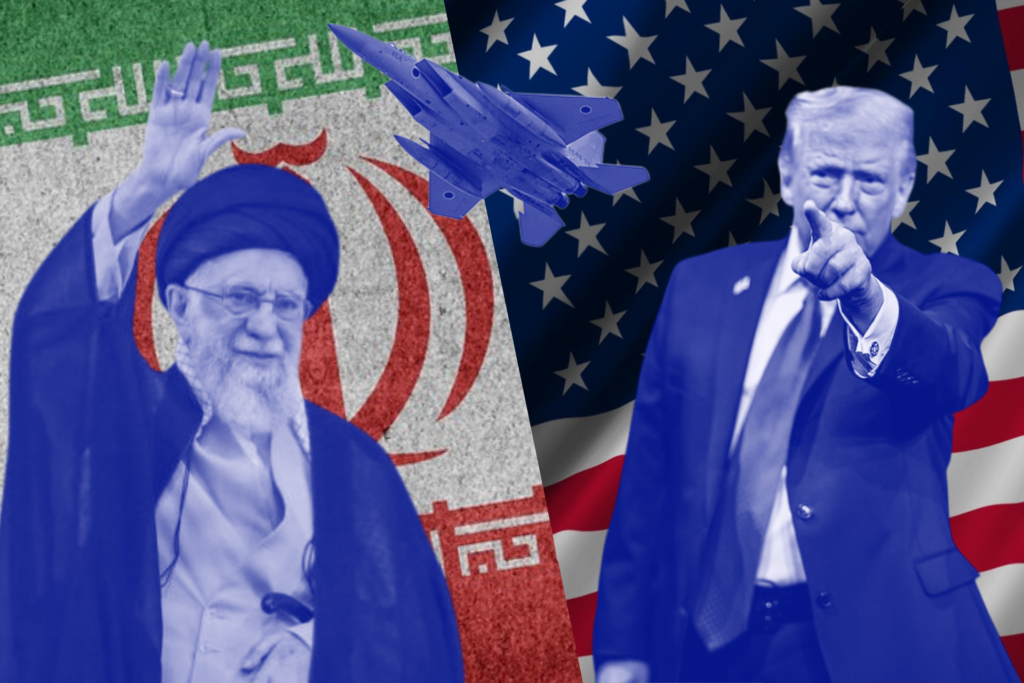
In the morning hours of 28th February, Israel and the United States “preventively” attacked Iran. They mainly bombed government buildings, however, the Iranian government claims that they also bombed civilian targets. During the attack, Iranian Supreme Leader Ali Khamenei, was killed. Ali Khamenei brutally ruled the country since 1983, having the blood of tens of thousands of Iranian people on his hands.
One would expect that the Iranian undemocratic regime was the main reason for the intervention… However, the United States and Israel justify their “preventive” attack by fearing that Iran was expanding its nuclear program. Note that both the US and Israel have their own nuclear programs – Israel even undeclared (similarly like Iran).
Iranian Nuclear Programme
Iran started to develop its nuclear program in the 50s. During the reign of Shah Mohammad Reza Pahlavi, who wanted to turn Iran into a modern, Western-style superpower. The Iranian nuclear program was on of the ways to achieve his goal. Shah worked on it with the United States as part of the “Atoms for Peace” program. A nuclear program for non-war purposes – so basically nuclear power plants.
Attention: When a country has a “nuclear program”, it doesn’t always mean they produce nuclear weapons. Nuclear program means even an ordinary nuclear power plant. However, if a country has a nuclear power plant, it’s theoretically able to produce nuclear weapons since the technology is similar.
After the Islamic Revolution of 1979, the situation reversed. The Supreme Leader Ruhollah Khomeini completely stopped the Iranian nuclear program, saying that it was “against Islamic values”.
But in the 80s, the Iranian government realized that if they wanted to be energy independent and able to scare-off neighboring countries (such as Iraq, which attacked them in the 80s), they simply needed the program… So they revived it again. Except this time Iran did not cooperate on it with the West, but with the Soviet Union, Pakistan and China.
Officially, this nuclear program was only for “peaceful purposes”. But if you started digging deeper into it, you would discover that the program was suspiciously big. Given that Iran had only one nuclear power plant – for example:
- Iran was enriching much more uranium than it needed for its one power plant
- They were exchanging classical weapons against nuclear know-how with nuclear-weapon states
- Iran was also modifying its ballistic missiles so that they could carry nuclear weapons
- an Iranian opposition group revealed secret underground nuclear facilities for enriching uranium
It was all revealed in 2002 during an IAEA (= International Atomic Energy Agency) inspection. Attempts followed to pressure Iran to limit its nuclear program. In 2003, Iran voluntarily signed and implemented the Additional Protocol to the Nuclear Non-Proliferation Treaty.
The Nuclear Non-Proliferation Treaty (NPT) is an international agreement signed in 1968 where countries possessing nuclear weapons (= United States, Russia, United Kingdom, France and China) promised not to use them or spread them to other countries, and eventually get rid of them completely. And the non-nuclear countries agreed to never try acquiring nuclear weapons. In return, the five nuclear countries promised to help them with a peaceful nuclear program (such as the Atoms for Peace).
In this Additional Protocol of NPT Iran agreed to permit more intensive IAEA inspections. But after two years it abandoned it. As a response Western countries imposed sanctions on Iran.
After very difficult negotiations, in 2015 then-US president Barack Obama managed to negotiate a Joint Comprehensive Plan of Action (JCOPA) with Iran. In this agreement Iran promised to limit its nuclear program for the next 15 years in exchange for the lifting of sanctions. In addition to the USA and Iran, the agreement was signed by 6 other powers, including China and Russia. But then one American president canceled it…
Surprise surprise, it was no one else than Donald Trump during his first presidency in 2018. Also, he imposed sanctions not only on Iran but also on European states if they wanted to trade with Iran. Since then, Iran has been moving closer to a nuclear weapon faster than before.
Could We Have Predicted the Attack on Iran ?
In July 2025, Israel attacked Iran, waging the so-called Twelve-Day War, which the United States later joined. It was an escalation of long-lasting rivalry between the two countries. Both had been indirectly attacking each other for a long time – this was their first direct clash.
Basically: Israel is a western ally in the Middle East who “guards”, that local states – which happened to emerge in territories rich in now highly valued oil and which also share the same religion – from forming another global power that could challenge Western hegemony. In return, the West helps Israel maintain its position in the Middle East. So that’s why, for example, Western countries tolerate Israel’s nuclear program, while opposing the nuclear program of countries like Iran.
Iran, even in its pre-revolutionary democratic era always had high ambitions. It wanted to become one of the great powers, not just be their ally. After the revolution, this ambition became even stronger, since the political leadership was officially anti-Western and on top of that there was the religious dimension.
But this is geopolitics. The official Israeli and US pretext was – already in July 2025 – the expansion of Iran’s nuclear program. Btw. after the Twelve Day War, Donald Trump bragged that Iran’s nuclear program was 100% destroyed.
Saturday’s attack was preceded by a series of negotiations between the US and Iran. These had been going on practically since the cancellation of the JCOPA in 2018. But they did not bring any success: Iran insisted on maintaining its nuclear program, the US on its absolute abolition.
The latest round of negotiations between the US and Iran took place in Geneva on Thursday 26th February – two days before the attack. Which proves that Trump did not really want an agreement but a war with Iran. A war he swore he wouldn’t start to his voters… You cannot coordinate a joint attack in a few hours – he had to plan it with Netanyahu for at least several weeks.
How Did Iran Respond to the Attack?
The Iranian regime repaid the payment – not to the United States, but to Israel. They also tried to cover up Khamenei’s death for several hours.
As for the Iranian people, they are now in a somewhat similar situation to the Venezuelans at the beginning of the year – after the US intervened and captured dictator Maduro. On the one hand, there is a chance the intervention of the United States and Israel would rid them of the autocratic misogynistic regime. But it is not 100% certain, after all, the Iranian regime does not stand on just one leader – it’s a whole system that will be extremely hard to eradicate. At the same time the Iranians are still quite fragmented – some of them even mourned Khamenei.
On the other hand, we must ask ourselves the same question as in the case of Venezuela: Who would rid them of this autocratic regime?
Because those people would be controversial Donald Trump and Benjamin Netanyau, who are both far from democratic leaders themselves.
Just a reminder:
- Donald Trump Violated the US Constitution by ending the birthright citizenship which guarantees an automatic American citizenship to anyone born in the US
- He sent armed units into the streets, killing over thirty people in 2025.
- In few weeks he singlehandedly destroyed international order by Invading Venezuela, claiming Greenland, and waging tariffs war with every country who is not compliant with his politics
- There is an international arrest warrant issued by the International Criminal Court (ICC) for Netanyahu on suspicion of war crimes
- Donald Trump not only violated this warrant when he didn’t arrest Benjamin Netanyahu after he entered US territory (as required by ICC) – but also sanctioned ICC judges for issuing the warrant.
What’s the Legal Side of the Attack on Iran?
In short, it is contrary to international law.
According to the United Nations Charter, “All Members shall refrain in their international relations from the threat or use of force against the territorial integrity or political independence of any state, or in any other manner inconsistent with the Purposes of the United Nations.”
In plain English: No UN member country can threaten or attack another country. Unless this country posed an “imminent threat” to them. But international law requires the threat to be real and immediate (like an actual attack). “Preventive” attacks are not supported by the law – but that is theory. In reality, when no one enforces the law, there are no consequences for breaking it…
At the same time, Iran is not a country that follows international law very much either – the Iranian regime has violated every agreement on nuclear weapons they could in the past, plus they constantly violate human rights of its own people.
Why should we care ?
Because this isn’t just about Iran. The US is the world’s most powerful country on which we are all dependent in some way (either economically, technologically, or politically).
Because the world already experienced similar US interventions that have not brought anything good, and left countries destabilized, with doors wide opened for the rise of undemocratic regimes:
- in Guatemala a CIA-backed coup in 1954 led to decades of civil war and genocide
- in Chile the US helped overthrow Salvador Allende in 1973, leading to Pinochet’s dictatorship
- the 2003 US invasion of Iraq, resulted in chaos, hundreds of thousands of deaths, and the rise of ISIS
- NATO’s 2011 intervention to Libya left the country in a state of civil war and lawlessness
Because this sets a dangerous precedent: If the US can invade a sovereign country, what’s stopping other powerful countries from doing the same to maybe even your country – who knows…