
US and Iran peace deal explained as if you were five
On 17th June, Iran and the United States signed a memorandum to end the war they have been waging since 28th February. Why? Read this article. What did each of them commit to in the memorandum? The best way to find out is, obviously, to read the memorandum directly. “But that memorandum is surely written in terribly difficult administrative English,” you say. And we hear you – therefore we translated it into the mere mortals’ English: Islamabad Memorandum of Understanding between the United States of America and the Islamic Republic of Iran 1 — The United States of America and the Islamic Republic of Iran and their allies in the current war are signing this MOU to declare the immediate and permanent termination of military operations on all fronts, including in Lebanon, and undertake from now on not to initiate any war or any military operation against each other, and to refrain from the threat or use of force against each other, and ensuring the territorial integrity and sovereignty of Lebanon. The final deal will confirm the permanent termination of the war on all fronts, including in Lebanon and other provisions of this paragraph. Translation: The war ends immediately. Both sides promise not to attack each other again – anywhere, not even in Lebanon. This also applies to their allies (a.k.a Israel and Hizballah). This memorandum is just the beginning – a proper final peace deal is yet to come. 2 — The United States of America and the Islamic Republic of Iran undertake to respect each other’s sovereignty and territorial integrity and to refrain from interfering in each other’s internal affairs. Translation: The US and Iran will respect each other’s territorial sovereignty and stop getting into each other’s business. 3 — The United States of America and the Islamic Republic of Iran commit to negotiating and achieving the final deal in maximum 60 days, extendable with mutual consent. Translation: After signing this memorandum they have 60 days to negotiate that proper final peace deal. If they both agree, they can extend this deadline. The Strait of Hormuz 4 — Immediately upon the signing of this MOU, the US will begin the removal of its naval blockade and any disturbances or impediments against Iran, and will fully end the naval blockade within 30 days. During this period, the traffic of vessels will be in proportion to the numbers of pre-war traffic being restored by Iran. The US further undertakes to remove its forces from the proximity of Iran within 30 days after the final deal. Translation: The Strait of Hormuz will be immediately reopened so that as many ships as before the war can pass. The US has 30 days to completely remove its military ships from Hormuz. And, once the final peace deal is signed, 30 days to remove its military forces from the region. 5 — Upon the signing of this MOU, Iran will make arrangements using its best efforts for the safe passage of commercial vessels with no charge, for 60 days only, from the Persian Gulf to the Sea of Oman and vice versa. The traffic of commercial vessels will immediately start, and considering the need for removing the technical and military obstacles, and demining by Iran will be instated within 30 days. Iran will conduct dialog with the Sultanate of Oman to define the future administration and maritime services in the Strait of Hormuz in discussion with other Persian Gulf littoral states in line with the applicable international law and the sovereign rights of coastal states of the Strait of Hormuz. Translation: Iran will reopen Hormuz. For the first 60 days, commercial ships can sail through there for free. Iran will also clear the mines they put there within 30 days. After that, Iran will negotiate with Oman and other Gulf countries about who runs the strait long-term. Financial side of the peace deal 6 — The United States of America undertakes with regional partners to develop a definitive, mutually agreed plan with at least USD 300 billion for the reconstruction and economic development of the Islamic Republic of Iran. The mechanism for the implementation of this plan will be finalized as part of a final deal within 60 days. All required licenses, waivers and permissions needed for the relevant financial transactions will be granted by the United States of America. Translation: The US and its allies will put together at least 300 billion $ to rebuild Iran. And what about sanctions? 7 — The United States of America undertakes to terminate all types of sanctions against the Islamic Republic of Iran, including the United Nations Security Council resolutions, IAEA Board of Governors resolutions, and all unilateral US sanctions, primary and secondary, in an agreed upon schedule as part of the final deal. The Islamic Republic of Iran and the United States of America acknowledge the critical importance of the sanctions termination issue above mentioned, and expressed their intentions to immediately address these issues in the negotiations in order to achieve mutual agreement on them. Translation: The US will drop all sanctions against Iran – everything, from UN resolutions to its own unilateral ones. And Iranian nuclear program? 8 — Iran reaffirms that it shall not procure or develop nuclear weapons. The US and Iran have agreed to resolve the disposition of stockpiled enriched material pursuant to a mechanism that will be mutually agreed upon in accordance with the schedule mentioned in paragraph seven, with the minimum methodology to be down blended on site under the supervision of the IAEA. The two parties also agreed to discuss the issue of enrichment and other mutually agreed matters related to the Islamic Republic of Iran’s nuclear needs, based on a satisfactory framework being agreed upon in the final deal. The final deal will confirm the provisions of this paragraph. The United States of America and the Islamic Republic of Iran acknowledge the critical importance of the nuclear issues above mentioned. They express their intention to immediately
Ceasefire between the US and Iran : Story of the Last Week
After 38 days of war between the US, Israel and Iran, on April 8th, two week ceasefire was announced What preceded the ceasefire? On 28th February, Israel and the United States “preventively” attacked Iran. You can read more in detail about this attack in our article : US & Israel Attack on Iran. Iran responded by attacking Israel back, and also attacking the allies of the United States and Israel in the region (like Kuwait, Saudi Arabia, Qatar, the United Arab Emirates, Bahrain, or Oman). Soon, military groups from Lebanon and Iraq joined Iran’s side. Iran also blocked the Strait of Hormuz, a strategic point in the world’s oil transportation. This led to an increase in the prices of oil and food (since oil is used for fertilizers and packaging). Donald Trump, the president of the US, didn’t expect this (although he should have). His loss of control over the situation was clearly visible in the level of hysteria in his posts on the Truth Social – a platform he created to communicate his decisions. He was alternating between announcing victory over Iran, negotiations with it, and giving it ultimatums… See for yourself: On April 8th, just hours before his last ultimatum was about to expire, he suddenly switched. And announced a two week ceasefire. How was the ceasefire negotiated ? The ceasefire may seem sudden, but in reality, weeks of negotiations preceded it. Actually, the US and Iran were negotiating even before the war started. Just two days before the “preventive” attack both countries met in Geneva to discuss Iran’s nuclear program (more details in this article). Immediately after the attack, Trump expected negotiations, which Iran denied. Negotiations restarted around mid-March, when the US delivered a 15-point plan to end the war to Iran via Pakistan. So far, this plan is not publicly available. However, the US was supposed to demand heavy restrictions of Iran’s nuclear program and its ballistic-missiles, end of Iran’s support for regional armed groups (like Hizballah in Libanon), and reopening the Strait of Hormuz. In return, the US would lift nuclear-related sanctions on Iran and help it to develop a civilian nuclear program. (This is basically what the US discussed with Iran in Geneva before attacking it.) Iran refused, proposing a 5-point plan instead. In which they demanded the US to stop killing Iranian officials, end all hostilities, guarantee that no other war is waged against Iran, pay reparations, and accept Iran’s sovereignty over the Strait of Hormuz. Pakistan, the mediator in this conflict, then issued another 5-point initiative together with China. Demanding immediate end of all hostilities, start of peace talks, security of nonmilitary targets, security of shipping lanes, and respect of the United Nations Charter. On 1st April, Trump claimed that Iran asked him for a ceasefire. Iran denied it. While Trump was giving ultimatums and tweeting that “the whole civilization will die tonight”, diplomatic negotiations were culminating in Pakistan. The American side was represented by the US vice president JD Vance, US special envoy to the Middle East Steve Witkoff, and Trump’s son in law Jared Kushner. The Iranian delegation was composed of Foreign Minister Abbas Araghchi, Parliament Speaker Mohammad Bagher Ghalibaf, and four senior commanders from Iran’s Revolutionary Guard. Although the composition of this group sounds a bit like the beginning of a joke, together they negotiated a temporary ceasefire. Terms of the ceasefire The ceasefire has 10 points. However, what these points are, is not yet crystal clear… Several versions are circulating in the press. And the whole situation is complicated by the fact that before this final 10-point plan, there was another 10-point plan proposed by Iran (and strongly rejected by the US). Certain is that the ceasefire will last for 14 days, during that time attacks on both sides will stop and the Strait of Hormuz will be reopened. The versions circulating in the press most often mention these other conditions : Aftermath The ceasefire is only a temporary solution. Diplomatic negotiations continue in its background. It is possible that the US and Iran will extend the ceasefire or end the war altogether. However, it is also possible that they will not reach an agreement and, when the ceasefire ends after two weeks, they will start attacking each other again. So far, this scenario seems more realistic given that: Why should we care about it? Because a ceasefire does not mean the end of the conflict. But people often make the mistake to interpret it that way. So, they miss the “final solution”. Remember how the ceasefire in Gaza turned out? – Exactly! Sources: Khamenei’s top aide Larijani rules out negotiations with US after Trump says ‘I have agreed to talk’ — What’s next for Iran Iran rejects US ceasefire plan, issues its own demands as strikes land across the Mideast – The Washington Post U.S. Sends Iran 15-Point Plan to End War | UANI Iran dismisses U.S. ceasefire plan, issues counterproposal as strikes land across the Mideast | PBS News Five-Point Initiative of China and Pakistan For Restoring Peace and Stability in the Gulf and Middle East Region_Ministry of Foreign Affairs of the People’s Republic of China Oil, strait of Hormuz and empty threats: a timeline of Trump’s flip-flopping on the Iran war | Donald Trump | The Guardian Pakistan says ceasefire efforts underway as Iran war continues | Arab News The Islamabad Accords: Framework, Preparations, and the Long View Iran warns it will respond if Israeli attacks on Lebanon don’t stop immediately – BBC News Has Iran’s 10-point plan changed, as JD Vance claims? | US-Israel war on Iran News | Al Jazeera Iran warns it will respond if Israeli attacks on Lebanon don’t stop immediately – BBC News What is Iran’s 10-point conditions for ceasefire and negotiations – The Hindu Will the Cease-Fire With Iran Hold? | Foreign Affairs What we know about the US and Iran’s ceasefire deal
World Trade Organisation Ministerial Conference : Story of the Last Week
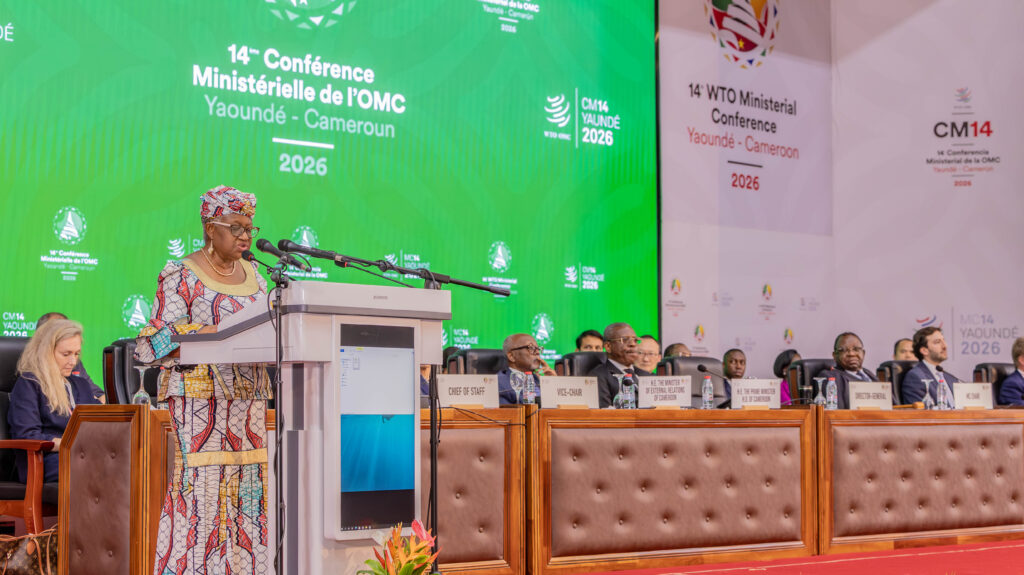
From March 26 to 29, 2026, the World Trade Organization (WTO) held its 14th Ministerial Conference (MC14) in Yaoundé, Cameroon. What is the World Trade Organisation Ministerial Conference? The Ministerial Conference is the top decision making body of the World Trade Organization. It happens usually every two years. It brings together trade ministers from WTO member countries to set the direction of global trade. The conference is also attended by various lobbyists, or NGOs who are trying to influence the decision making. What is the World Trade Organization? The World Trade Organization (WTO) is an international organization based in Geneva. Its main role is to set the rules for international trade and make sure smaller countries don’t get crusehd by economic giants. Founded in 1995, it replaced the General Agreement on Tariffs and Trade (GATT). The GATT was signed in 1948 to reduce barriers to international trade. Which helped rebuild the economy after World War II. Nowadays the WTO has 166 member countries. What was on the table at MC14? Fisheries subsidies – a.k.a. fight against illegal fishing The biggest deal at MC14 was an agreement to ban fisheries subsidies that encourage overfishing. This agreement was negotiated back in 2022, but has only officially entered into force now. The agreement specifically bans subsidies that enable illegal, unreported, or unsustainable fishing. Like subsidies for vessels that violate quotas, fish in protected areas, or target overfished species (like bluefin tuna). Thanks to this agreement illegal fishing will lose its profitability and therefore its appeal to people. However, since this measure relies on self-reporting of governments, there are still some possible loopholes. For example, countries that profit from illegal fishing may try to manipulate the data… But that’s why the Committee on Fisheries Subsidies was established this year to oversee implementation of the Agreement. At the same time there is also the so-called “Fish fund”. WTO member countries can contribute to it to help developing and least-developed countries implement the Agreement. Investment Facilitation for Development (IFD) – a.k.a. attracting foreign investors to developing countries During the Conference ministers were also discussing the IFD Agreement. Which was negotiated in 2023 at the initiative of developing countries that wished to attract foreign investors. The IFD Agreement helped them to do that. Because it introduced measures that make investing in those countries easier for foreign investors. For example, it sets consistent global rules for investing, so businesses know what to expect in any country. And since these rules can only be reformed at the international level, they are immune against local political instabilities. This gives investors a greater sense of security. The Agreement also guarantees technical assistance to developing countries and creates a global forum where they can share their practices, and help each other. Although the Agreement was concluded in 2023, it is not yet in force. That was the subject of this year’s Conference, where countries discussed the incorporation of the IFD Agreement into the legal framework of the WTO. Concretely into the 4th article of the WTO Agreement a.k.a. the Marrakesch Agreement (= the founding document of the WTO). Only after this implementation will the IFD Agreement enter into force. E-Commerce and customs – a.k.a. will we pay customs duty for sending an email? 💡 e-commerce = buying and selling of goods and services over the internet (via websites, mobile apps, social media…) Like every Conference, this year ministers debated extending the so-called “Moratorium on customs duties for electronic transmissions“. This moratorium ensures that cross-border electronic transmissions – like sending an email, making a Zoom call, streaming a movie, or an online payment – remain tariff-free (unlike physical goods). Although the Moratorium has been in place since 1998, when WTO members agreed not to impose tariffs on digital transmissions (because it was simpler and cheaper that way), it is not permanent. The moratorium only lasts two years, and every Conference countries must vote to renew it. But not all of them agree. While countries that export digital services (like the US) support the Moratorium. Nations that import these services (and aspire to develop their own) naturally oppose it. Because if the Moratorium wasn’t extended, they could impose tariffs on US Big Tech, which would gain them some money and reduce the foreign competition to their national tech companies. This year’s Conference discussed possible reforms to Moratorium (like making it permanent or creating a special committee for it). But in the end, the Moratorium was just simply extended as usual. Boost for small economies The ministers also adopted two measures to economically boost so-called Least Developed Countries (LDCs) = the world’s poorest nations: Why should we care? Because the decisions that are made at the conference affect the entire world market . Which means that the WTO is often directly or indirectly responsible for how much things cost. Because watching the conference and understanding what is being decided makes you realize that some countries that are considered “incompetent” are not succeeding because they are lazy and not trying hard enough… But because some decisions of the majority simply don’t work in their favor. Because in the midst of all the wars and aggressions today, the Conference where countries work together instead of fighting, restores a faith in humanity a bit. Sources WTO | Understanding the WTO – Whose WTO is it anyway? MC14 opens in Yaoundé with call to reinvigorate WTO in time of crisis Ministers exchange views on key WTO topics, consider paths forward at MC14 The WTO Agreement on Fisheries Subsidies Investment Facilitation for Development Agreementf EU and other WTO Members reach landmark deal to facilitate investment and support development – Trade and Economic Security Members participating in IFD showcase progress, urge incorporation of Agreement into WTO MC14 event calls for scaling up support for Trade in Services for Development initiative WTO | E-commerce – Briefing note – 14th WTO Ministerial Conference Members adopt a pathway to bring E‑Commerce Agreement into force via interim arrangements Adding value to cotton in Africa