
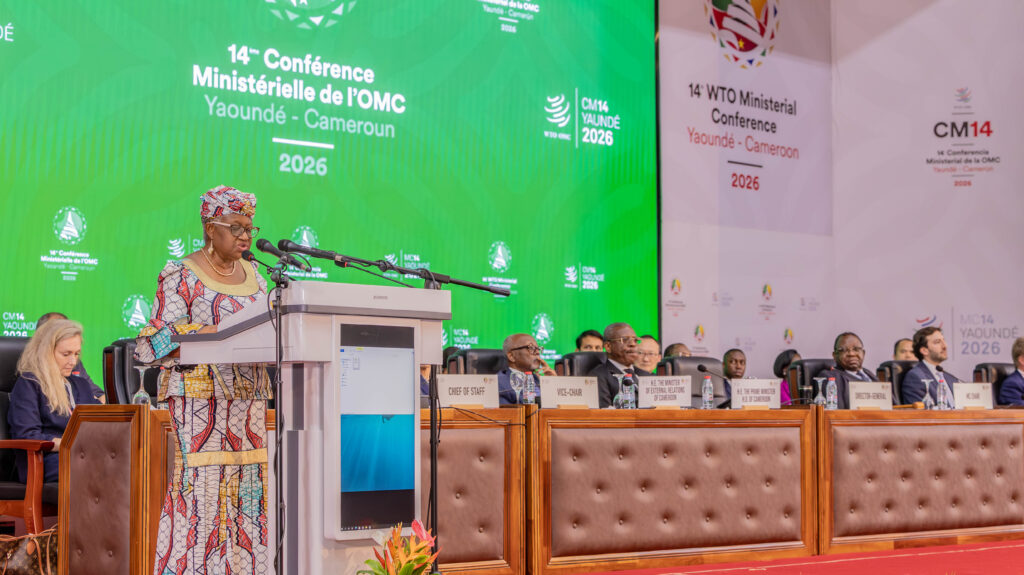
From March 26 to 29, 2026, the World Trade Organization (WTO) held its 14th Ministerial Conference (MC14) in Yaoundé, Cameroon.
What is the World Trade Organisation Ministerial Conference?
The Ministerial Conference is the top decision making body of the World Trade Organization. It happens usually every two years. It brings together trade ministers from WTO member countries to set the direction of global trade. The conference is also attended by various lobbyists, or NGOs who are trying to influence the decision making.
What is the World Trade Organization?
The World Trade Organization (WTO) is an international organization based in Geneva. Its main role is to set the rules for international trade and make sure smaller countries don’t get crusehd by economic giants. Founded in 1995, it replaced the General Agreement on Tariffs and Trade (GATT). The GATT was signed in 1948 to reduce barriers to international trade. Which helped rebuild the economy after World War II. Nowadays the WTO has 166 member countries.
What was on the table at MC14?
Fisheries subsidies – a.k.a. fight against illegal fishing
The biggest deal at MC14 was an agreement to ban fisheries subsidies that encourage overfishing. This agreement was negotiated back in 2022, but has only officially entered into force now. The agreement specifically bans subsidies that enable illegal, unreported, or unsustainable fishing. Like subsidies for vessels that violate quotas, fish in protected areas, or target overfished species (like bluefin tuna). Thanks to this agreement illegal fishing will lose its profitability and therefore its appeal to people. However, since this measure relies on self-reporting of governments, there are still some possible loopholes. For example, countries that profit from illegal fishing may try to manipulate the data… But that’s why the Committee on Fisheries Subsidies was established this year to oversee implementation of the Agreement. At the same time there is also the so-called “Fish fund”. WTO member countries can contribute to it to help developing and least-developed countries implement the Agreement.
Investment Facilitation for Development (IFD) – a.k.a. attracting foreign investors to developing countries
During the Conference ministers were also discussing the IFD Agreement. Which was negotiated in 2023 at the initiative of developing countries that wished to attract foreign investors. The IFD Agreement helped them to do that. Because it introduced measures that make investing in those countries easier for foreign investors. For example, it sets consistent global rules for investing, so businesses know what to expect in any country. And since these rules can only be reformed at the international level, they are immune against local political instabilities. This gives investors a greater sense of security. The Agreement also guarantees technical assistance to developing countries and creates a global forum where they can share their practices, and help each other.
Although the Agreement was concluded in 2023, it is not yet in force. That was the subject of this year’s Conference, where countries discussed the incorporation of the IFD Agreement into the legal framework of the WTO. Concretely into the 4th article of the WTO Agreement a.k.a. the Marrakesch Agreement (= the founding document of the WTO). Only after this implementation will the IFD Agreement enter into force.
E-Commerce and customs – a.k.a. will we pay customs duty for sending an email?
💡 e-commerce = buying and selling of goods and services over the internet (via websites, mobile apps, social media…)
Like every Conference, this year ministers debated extending the so-called “Moratorium on customs duties for electronic transmissions“. This moratorium ensures that cross-border electronic transmissions – like sending an email, making a Zoom call, streaming a movie, or an online payment – remain tariff-free (unlike physical goods). Although the Moratorium has been in place since 1998, when WTO members agreed not to impose tariffs on digital transmissions (because it was simpler and cheaper that way), it is not permanent. The moratorium only lasts two years, and every Conference countries must vote to renew it. But not all of them agree.
While countries that export digital services (like the US) support the Moratorium. Nations that import these services (and aspire to develop their own) naturally oppose it. Because if the Moratorium wasn’t extended, they could impose tariffs on US Big Tech, which would gain them some money and reduce the foreign competition to their national tech companies. This year’s Conference discussed possible reforms to Moratorium (like making it permanent or creating a special committee for it). But in the end, the Moratorium was just simply extended as usual.
Boost for small economies
The ministers also adopted two measures to economically boost so-called Least Developed Countries (LDCs) = the world’s poorest nations:
- Better integration of small economies into the multilateral trading system. Because this system was built by (and for) wealthy nations, with rules that favor big actors and leave smaller economies behind. In practice this measure will simplify bureaucracy, offer technical or financial support to LDCs (like grants or partnership…)
- Exceptions from some sanitary regulations and technical norms. Because the current trade standards are often too complex, or expensive, so the small businesses from poor countries can’t afford to comply with them. So they end up being outcompeted by big businesses from rich countries that have more ressources. In practice this measure will make testing cheaper for those countries, or give them funding for certifications…
Why should we care?
Because the decisions that are made at the conference affect the entire world market . Which means that the WTO is often directly or indirectly responsible for how much things cost.
Because watching the conference and understanding what is being decided makes you realize that some countries that are considered “incompetent” are not succeeding because they are lazy and not trying hard enough… But because some decisions of the majority simply don’t work in their favor.
Because in the midst of all the wars and aggressions today, the Conference where countries work together instead of fighting, restores a faith in humanity a bit.
Sources
WTO | Understanding the WTO – Whose WTO is it anyway?
MC14 opens in Yaoundé with call to reinvigorate WTO in time of crisis
Ministers exchange views on key WTO topics, consider paths forward at MC14
The WTO Agreement on Fisheries Subsidies
Investment Facilitation for Development Agreementf
Members participating in IFD showcase progress, urge incorporation of Agreement into WTO
MC14 event calls for scaling up support for Trade in Services for Development initiative
WTO | E-commerce – Briefing note – 14th WTO Ministerial Conference
Members adopt a pathway to bring E‑Commerce Agreement into force via interim arrangements
Adding value to cotton in Africa can drive inclusive growth, ministers and agency heads say