
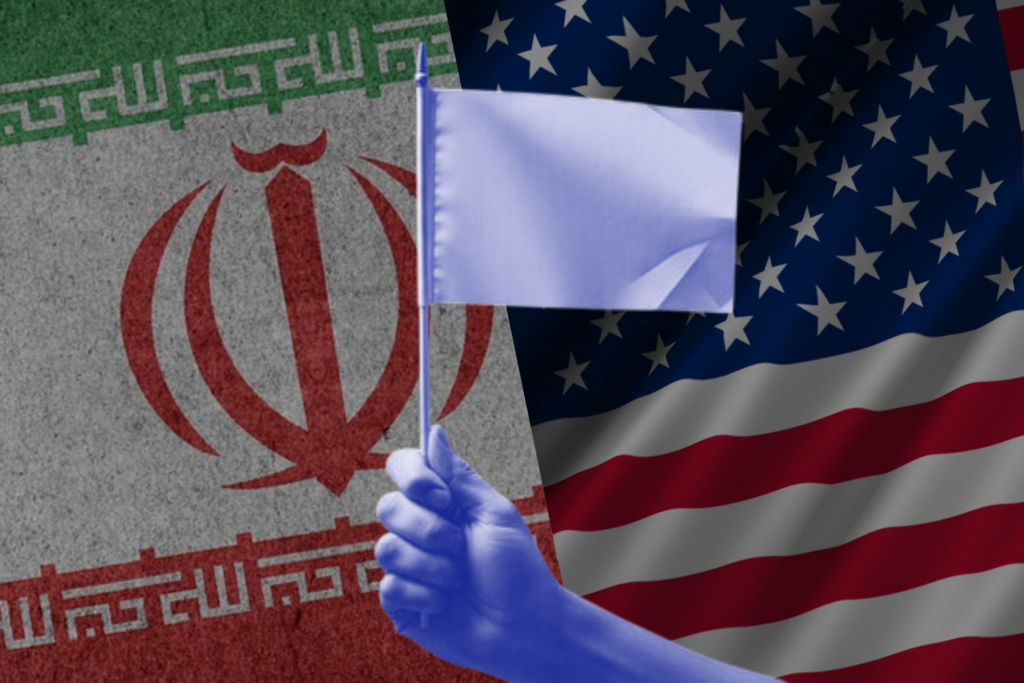
After 38 days of war between the US, Israel and Iran, on April 8th, two week ceasefire was announced
What preceded the ceasefire?
On 28th February, Israel and the United States “preventively” attacked Iran. You can read more in detail about this attack in our article : US & Israel Attack on Iran.
Iran responded by attacking Israel back, and also attacking the allies of the United States and Israel in the region (like Kuwait, Saudi Arabia, Qatar, the United Arab Emirates, Bahrain, or Oman). Soon, military groups from Lebanon and Iraq joined Iran’s side.
Iran also blocked the Strait of Hormuz, a strategic point in the world’s oil transportation. This led to an increase in the prices of oil and food (since oil is used for fertilizers and packaging).
Donald Trump, the president of the US, didn’t expect this (although he should have). His loss of control over the situation was clearly visible in the level of hysteria in his posts on the Truth Social – a platform he created to communicate his decisions. He was alternating between announcing victory over Iran, negotiations with it, and giving it ultimatums… See for yourself:

On April 8th, just hours before his last ultimatum was about to expire, he suddenly switched. And announced a two week ceasefire.
How was the ceasefire negotiated ?
The ceasefire may seem sudden, but in reality, weeks of negotiations preceded it. Actually, the US and Iran were negotiating even before the war started. Just two days before the “preventive” attack both countries met in Geneva to discuss Iran’s nuclear program (more details in this article).
Immediately after the attack, Trump expected negotiations, which Iran denied. Negotiations restarted around mid-March, when the US delivered a 15-point plan to end the war to Iran via Pakistan. So far, this plan is not publicly available. However, the US was supposed to demand heavy restrictions of Iran’s nuclear program and its ballistic-missiles, end of Iran’s support for regional armed groups (like Hizballah in Libanon), and reopening the Strait of Hormuz. In return, the US would lift nuclear-related sanctions on Iran and help it to develop a civilian nuclear program. (This is basically what the US discussed with Iran in Geneva before attacking it.)
Iran refused, proposing a 5-point plan instead. In which they demanded the US to stop killing Iranian officials, end all hostilities, guarantee that no other war is waged against Iran, pay reparations, and accept Iran’s sovereignty over the Strait of Hormuz.
Pakistan, the mediator in this conflict, then issued another 5-point initiative together with China. Demanding immediate end of all hostilities, start of peace talks, security of nonmilitary targets, security of shipping lanes, and respect of the United Nations Charter.
On 1st April, Trump claimed that Iran asked him for a ceasefire. Iran denied it.
While Trump was giving ultimatums and tweeting that “the whole civilization will die tonight”, diplomatic negotiations were culminating in Pakistan. The American side was represented by the US vice president JD Vance, US special envoy to the Middle East Steve Witkoff, and Trump’s son in law Jared Kushner. The Iranian delegation was composed of Foreign Minister Abbas Araghchi, Parliament Speaker Mohammad Bagher Ghalibaf, and four senior commanders from Iran’s Revolutionary Guard. Although the composition of this group sounds a bit like the beginning of a joke, together they negotiated a temporary ceasefire.
Terms of the ceasefire
The ceasefire has 10 points. However, what these points are, is not yet crystal clear… Several versions are circulating in the press. And the whole situation is complicated by the fact that before this final 10-point plan, there was another 10-point plan proposed by Iran (and strongly rejected by the US).
Certain is that the ceasefire will last for 14 days, during that time attacks on both sides will stop and the Strait of Hormuz will be reopened.
The versions circulating in the press most often mention these other conditions :
- end of the hostilities in the whole region (which, if true, Israel violated on the very first day by attacking Libanon)
- Iran’s commitment to not seeking nuclear weapons
- United States’s commitment to lift sanctions on Iran, return its confiscated properties and money abroad, and pay them war reparations
Aftermath
The ceasefire is only a temporary solution. Diplomatic negotiations continue in its background. It is possible that the US and Iran will extend the ceasefire or end the war altogether. However, it is also possible that they will not reach an agreement and, when the ceasefire ends after two weeks, they will start attacking each other again. So far, this scenario seems more realistic given that:
- the first talk after the ceasefire went unsuccessful
- 5 days after the ceasefire, Trump started blocking of the Strait of Hormuz for ships departing from or arriving in Iranian ports
Why should we care about it?
Because a ceasefire does not mean the end of the conflict.
But people often make the mistake to interpret it that way.
So, they miss the “final solution”. Remember how the ceasefire in Gaza turned out? – Exactly!
Sources:
U.S. Sends Iran 15-Point Plan to End War | UANI
Pakistan says ceasefire efforts underway as Iran war continues | Arab News
The Islamabad Accords: Framework, Preparations, and the Long View
Iran warns it will respond if Israeli attacks on Lebanon don’t stop immediately – BBC News
Has Iran’s 10-point plan changed, as JD Vance claims? | US-Israel war on Iran News | Al Jazeera
Iran warns it will respond if Israeli attacks on Lebanon don’t stop immediately – BBC News
What is Iran’s 10-point conditions for ceasefire and negotiations – The Hindu