
Israel’s death penalty law for Palestinians : Story of the Last Week
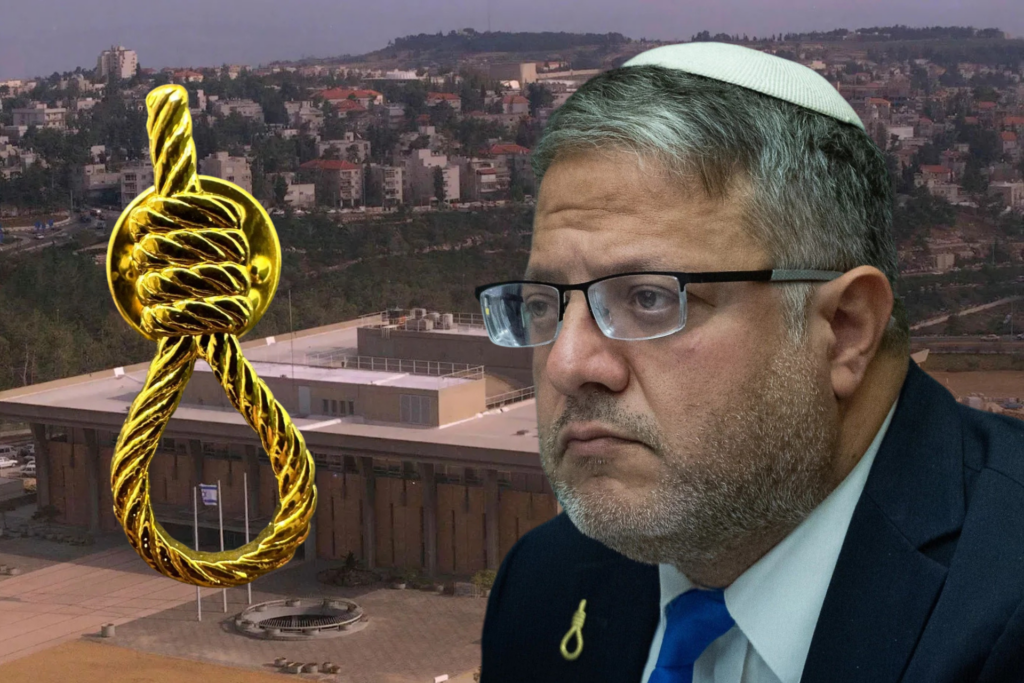
On March 30, 2026, the Israeli parliament (= Knesset), passed a controversial law allowing the death penalty by hanging for Palestinians living in the West Bank convicted of terrorism. What’s this law about? Let’s look at its key excerpt: “A resident of the Area who intentionally causes the death of a person, where the act constitutes an act of terrorism as defined in the Counter-Terrorism Law, shall be sentenced to death, and this punishment only; however, if the Military Court finds, that special circumstances exist for which it is appropriate to sentence the terrorist to life imprisonment, it may impose such a sentence” By “Area” law means Judea and Samaria, which is the West Bank of the Jordan. And by “resident of the Area” law means a person “who is registered in the population registry of the Area or one who resides in the Area even if not registered in said registry, excluding an Israeli citizen or an Israeli resident” 💡: For the original law see here, you can find the unofficial English translation here. Why is it controversial? By its formulation, the law explicitly excludes Israelis from the death penalty, so it doesn’t apply to everyone equally. This is a discriminatory practice that is against the constitution which says that all people are equal. According to the law, executions are fasttracked and stripped of safety mechanisms. The death penalty can be simply decided by a majority of the court without the prosecutor having to propose it. And the execution should be carried out within 90 days of the verdict. Convicted people should not be allowed to receive visitors in prison beforehand. And they can consult their lawyers only via video calls. The death penalty is the default punishment unless the court finds “special circumstances” to change the sentence to life imprisonment. However, the law does not define what these “special circumstances” are, leaving it open to interpretation. Moreover, the law is not “kosher” even according to Jewish morality… Judaic texts say, the death penalty is possible. But they also say that a court that issues a death sentence more often than once every 70 years is considered a bloody court. For this reason, some representatives of Orthodox parties also have a problem with the law. Who wanted this law? The law was presented by Israeli far-right political party Otzma Yehudit. After current Israeli prime minister Benjamin Netanyahu won the 2022 parliamentary elections with his right-wing Likud party, he formed a coalition with Otzma Yehudit, and other far-right parties to gain the majority in the parliament. Otzma Yehudit is an ultranationalist, kahanist party. Kahanism is a movement aiming for the total expulsion of Palestinians from both Israeli and Palestinian territories created by Orthodox US-born rabbi Meir Kahane. Kahane later founded the Jewish Defense League and Kach party. Both of these organized numerous attacks on Arabs in the US, Israel and sometimes other countries. The Kach party was ultimately banned in Israel for its extremist views and listed as a terrorist organisation in the US. Otzma Yehudit is sometimes considered as a kind of successor to Kach. And its leader Itamar Ben-Gvir, currently serving as Israel’s National Security Minister, is not beating the allegations… In the past, he has been convicted of incitement to racism and supporting a terrorist organization for carrying signs saying, “Expel the Arab enemy” and “Rabbi Kahane was right: The Arab MKs are a fifth column.” The fact that the members of the party wore noose-shaped pins to show their support of the law only underlines what kind of party it is… The law passed with 62 votes in favor and 48 against. Are all Israelis in favor of this law? Not all of them. Although after the Hamas attack on Israel on October 7, 2023, Israel is much more radical on security issues, and the society is in favor of similar radical laws (mainly because the current far-right government fuels hostile sentiments towards the Palestinians), some Israelis, human rights organization, legal experts and Knesset members still criticise the law. Given how discriminatory the law is, it wouldn’t be surprising if the Supreme Court struck it down. Yes, the same Supreme Court whose powers Netanyahu successfully tried to limit with his so-called “judicial reform” in 2023… What does this law mean for Israel? The law, naturally, doesn’t create a good image of Israel abroad… It is criticized by the United Nations, Amnesty International, and many countries including Germany, France, Italy, Great Britain, Spain or Ireland… The law thus joins a series of Israeli controversies that are gradually increasing negative views of Israel abroad. The most recent such controversy was Israel’s preventive attack on Iran, joined by the United States. This attack destabilised the whole Middle East and skyrocketed oil prices. As a result, negative views of Israel are also growing in the US, which has always been Israel’s greatest ally – some Americans don’t consider the war in Iran an American war, but an Israeli war into which they have been dragged… Even inside Israel, the law risks deepening divisions. Many Israelis, especially those on the political left and within the human rights community, see it as a dangerous step toward authoritarianism. Why should we care? Because this law does not apply equally to everyone. If we do not want to live in an Orwellian novel, then that should be reason enough Because this law is a part of a broader current world trend, where democratic institutions are being weakened in the name of “higher good”, “greater efficiency”, or “reduced costs”. Don’t buy this Because this is the prime example of what happens if you let extremists into your government: not only will it disrupt order in your country, and bring injustice, but it will also ruin your foreign reputation Sources: The death penalty law for Palestinians convicted of deadly acts of terror is unconstitutional | The Times of Israel Israel: Discriminatory Death Penalty Bill Passes | Human Rights Watch Palestinians convicted of lethal attacks face
Protests in Iran: Story of the Last Week

Over the past week, Iran has seen a new wave of protests. It all started economically on December 28, 2025, in Tehran, Iran’s capital, when local merchants protested after another sharp drop of the Iranian currency (the rial). This time, however, it reached its lowest value in history: inflation has risen to 40%. Iran’s worsening economic situation is due to both corruption and sanctions imposed on Iran over its nuclear program. Students soon joined, and the demonstrations turned political, with slogans targeting Supreme Leader Ali Khamenei. While Iran has a president, his role is purely ceremonial. The real power lies with the Supreme Leader – a position created after the 1979 revolution, when Iran became an Islamic state. Only two men have held this lifelong role: Ruhollah Khomeini and the current leader, Ali Khamenei, who has ruled for 36 years and is now facing protests The protests in Iran are the largest protests since 2022, with over 550 people killed and 20,000 detained after the death of Mahsa Amini. But let’s start from the beginning… How did Iran get here? Although Russia and Britain always tried to get Iran under their influence, Iran maintained its independence for a long time. Until World War II, when it sided with Germany. Fearing this alliance, Britain and the USSR invaded, removed the Shah, and installed his son, Mohammad Reza Pahlavi. Unlike his father, the new Shah was not afraid to open the country to foreign – mainly Western – influences. But the Iranian people were a bit more skeptical of his open foreign policy. In 1951, they democratically elected Mohammad Mossadegh as prime minister. Mossadegh nationalized Iran’s oil industry, controlled by the British at that time. This upset the British, so they convinced the US that Mossadegh’s rule would inevitably lead to a communist coup and that Iran would side with the Soviet Union in the Cold War. In 1953, the American and British secret services orchestrated a coup, overthrowing Mossadegh. Initially, Mohammad Reza was against it, but he quickly realized that with such an attitude, the British and Americans wouldn’t let him stay in power for long, so eventually, he joined the coup. Because of that, the Iranians started to consider him a coward. To prove to them (and to himself) that he was not, he began to implement various socio-economic reforms. His goal? To turn Iran into a modern, Western-style superpower. He redistributed land from large landowners to small farmers, built dams and power plants, fighted illiteracy, and gave women the right to vote… And, to REALLY show that he was no coward, he became more autocratic. He even established a secret police, SAVAK, that brutally suppressed any opposition to him. Mohammad Reza’s style of government inevitably led to increased US influence in Iran – at least economically. Concerning security, the Americans were not so eager to guarantee military help to Iran in case of an attack by the USSR. But if the mountain will not come to Muhammad, then Muhammad will go to the mountain. In this case, Mohammad Reza began negotiations with the Soviet Union about a non-aggression pact. Of course, the American president didn’t like that, so he convinced Mohammad to back down from these negotiations – which in turn angered the Soviet Union, who began supporting Mohammad Reza’s opponents. Iran Islamic revolution in 1979 And he had quite a few opponents: Ruhollah Khomeini, a Shia cleric, became the loudest critic of Mohammad Reza’s rule – not only in religious circles – he managed to appeal to a wide spectrum of dissatisfied people. What’s the difference between Shia and Sunni Islam? Simply put, the two groups differ over who they recognize as Muhammad’s rightful successor. Shia Muslims (the majority in Iran) believe leadership should be hereditary, passing to Muhammad’s descendants. Sunni Muslims (the majority globally) argue that the leader should be elected. The Revolution Anti-government protests began in October 1977 and gradually intensified, escalating in the spring of 1979, when Mohammad Reza fled into exile and Khomeini took over the government. Shortly after, he held a referendum on whether Iran “should become an Islamic Republic or not”. According to official results, 99% of people voted “yes,” and the turnout was 99%. Mohammad Reza was indeed unpopular, but the fact that the elections were held publicly and that the ballots were color-coded (green for yes, red for no) certainly played some role in this result. At the same time, the question “Islamic Republic: yes or no” is quite vague. Even today, in the age of the internet, it’s hard to understand what you’re signing up for – let alone in the 70s as someone living in extreme poverty… Many, focused on survival, didn’t grasp the implications until later – when it was too late. Life Under Sharia Law Since the revolution, Iran’s legal and political system has been strictly based on so-called Sharia law. Sharia law is not some uniformly codified law written in black and white somewhere. It’s more like different interpretations of how people should live according to the Quran (in the case of Iran, this interpretation is led by the Supreme Leader). This is a deeply problematic system because everyone can interpret the Quran basically however they want, since Islam does not have any central authority, like the Pope, to which they would be accountable. Iran is living proof of that. What exactly does living in accordance with the Quran mean according to its Supreme Leaders? For example: Sanctions on Iran Frankly, it’s primarily women who are negatively affected. But they are not the only ones with a reason to protest: Since the revolution, Iran has been regularly subject to sanctions – mainly from the United Nations, US, UK, and EU, primarily because of its nuclear program (on which Iran cooperates with China and Russia). Sanctions have led to an increasingly deteriorating economic situation, affecting everyone. There have been several big protests in Iran’s history: Unfortunately for Iranians, each wave of protest has been met