
Elections in Hungary : Who is Péter Magyar ?

For 16 years, Viktor Orbán’s conservative, Eurosceptic and openly pro-Russian Fidesz party ruled (and slowly eroded democracy in) Hungary. But last Sunday’s parliamentary elections brought an end to his rule. On 12th April 2026, Hungary elected Péter Magyar and his Tisza party. Who is Péter Magyar and how much of a change he is for Hungary? Who Is Péter Magyar? Péter Magyar wasn’t always Orbán’s enemy… As a lawyer from a rich family with Catholic education, he was actually the prototype of a Fidesz party member. And so was his wife, Judith Varga, the Minister of Justice under Orbán’s government. For years, Magyar moved in Fides’s inner circle. He held well-paid positions in state and semi-state companies, including the Hungarian Development Bank or the Student Loan Center. But everything changed in 2024… From Orbán’s ally to his greatest enemy In February 2024, it was revealed that Hungary’s president Katalin Novák had pardoned a man convicted of helping cover up child sexual abuse in a state-run children’s home. The pardon was signed by Judith Varga. The scandal shocked Hungary. It was one of the first moments when some of Fidesz’s supporters started questioning their choices. Both Novák and Varga resigned. But these two were only the top of the iceberg – its underwater part remained unmelted. And Péter Magyar started to criticise it. Even though at that time he was already divorced from Varga, at first he somehow defended her in his Facebook post by saying that he “doesn’t want to be a part of a system when the true leaders hide behind women’s skirts.” However, he soon sharpened his rhetoric against Varga too and released a recording he secretly made of her. In this recording Varga describes how government officials removed evidence from court records to cover up their role in corruption. Varga responded by accusing Magyar of domestic violence. Magyar denied, calling it a smear campaign to discredit him. As a result of the whole affair, and Magyar’s appearances in the opposition media (like the below Partizán), where he criticized the Orbán government, Magyar gained visibility and peoples’ trust. Since the European Parliament elections were approaching at that time, he decided to try his political chance. Tisza party Since Magyar didn’t have the time to create a political party “from scratch”, he revived Tisza, a small, and to that point non-significant party. Tisza is a combination of the beginnings of the Hungarian words “respect” and “freedom”. Created in 2020 as an opposition to Viktor Orbán, Tisza was a conservative, pro-European party. We would find it more on the center-right / right side of the political spectrum. However, Tisza has always been (and even under Magyar still is) a populist party. Marketing itself as a party “for all” without taking a clear ideological position so it wouldn’t discourage some of its diverse voters. In the two months remaining until the European election, Péter Magyar managed to gain so much support that he ended up second with 29% of the vote. Why Magyar won? Whereas Orbán built his program on polarizing topics such as LGBTQ+ rights or migration, Magyar focused on fighting issues that everyone could agree are objectively problematic : like corruption, deteriorating healthcare or education… – even voters who wouldn’t normally vote for conservatives. Magyar also managed to market Tisza as a party that came “from below” but that is, at the same time, full of strong leaders who know what they are doing. He mobilized activists in smaller towns. This gave people the impression that with Tisza they can be directly involved in politics, and helped spread the campaign outside of the capital Budapest. At the same time, he filled key party positions with professionals with rich leadership and managerial experience they gained by working for big companies like Shell or Vodafone. Last but not least, Magyar managed to “bypass” pro-orban media by leading an intensive campaign on social media and at the same time meeting voters face to face. Even in areas with a large share of Orbán voters where other opposition parties had already given up. Why should we care ? Because under Orbán Hungary was Russia’s closest ally in the EU. Sometimes even called “Putin’s Trojan Horse”. Since many decisions in which the EU would have taken a more severe stance towards Russia (like freezing Russian assets in Europe or sending financial help to Ukraine) had to be made unanimously and Hungary blocked it. Because the Hungarian case gives hope. Even though, during his 16 years rule, Orbán damaged the democratical system (gaining control over the media, changing laws in his favour…) he didn’t destroy it completely. Magyar’s victory shows that even in a semi-authoritarian state, democracy still has a chance. But people need to fight for it – it won’t happen by itself. Because Magyar is still a populist. His political development shows that he is capable of opportunistically changing his mind as it suits him. And such people can be dangerous. They often start as reformers, but end up authoritarian. We don’t have to go too far for an example – even Orbán posed as an alternative at the beginning and look how it turned out… So we can celebrate, but we should also stay cautious. Sources Who is Péter Magyar, the former Orbán ally heading for power in Hungary? Who is Peter Magyar, Hungary’s new leader who trounced Viktor Orban? Former Hungarian insider releases audio he says is proof of corruption in embattled Orbán government Ex-wife hits out at Hungarian opposition leader Péter Magyar, calling him a traitor How Hungary’s Child Sex Abuse Scandal Contributed To Orban’s Downfall Meet the man behind the downfall of Hungary’s president No Safe Place: How Hungary’s Child Care Abuse Scandal Betrays Romani Children Explaining Tisza’s Hungarian breakthrough
Hungary Blocking Aid for Ukraine : Story of the Last Week
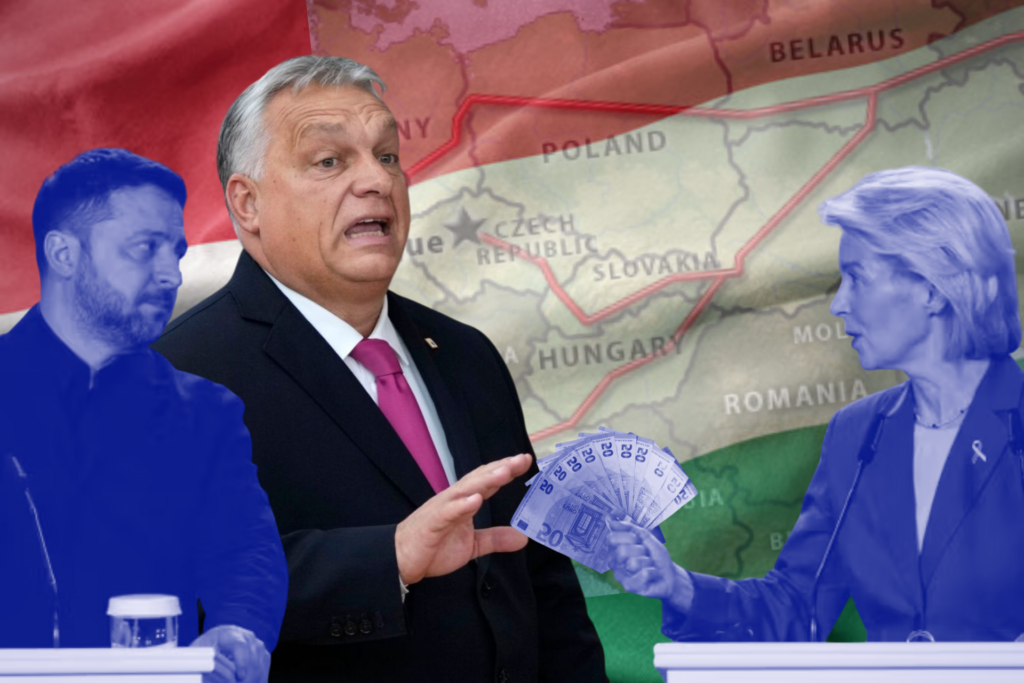
Even after the European Council summit, last week Hungary is still blocking the 90 billion euro loan for Ukraine. How is this even possible? And why is Hungary doing it? What was the loan about? In February 2026, the European Parliament approved a 90 billion euro loan for Ukraine to help it resist Russia’s invasion. The loan was agreed under so-called enhanced cooperation procedure – mechanism that allows something to be implemented within the EU even if not all 27 member countries agree on it. All financial responsibility for it then goes only to the countries that wanted it – not to the EU as a whole. In this case, 24 EU member states supported the loan for Ukraine, except the Czech Republic, Hungary and Slovakia. Ukraine was supposed to repay the loan after it received war reparations from Russia. Wait, how come Hungary is blocking the loan, when it doesn’t have to participate in it, you may wonder… How can Hungary block the loan if it’s not obliged to pay? The problem is the loan was meant to come from the EU’s joint budget. And when it comes to paying something from the EU joint budget, all member states must agree on it – even those that won’t contribute financially. If they don’t agree, they can use veto, that blocks everything. Which is exactly what Hungary, and its prime minister Victor Orbán, is doing right now. Why is Orbán doing it? Victor Orbán claims Hungary is blocking the loan because Ukraine stopped oil flows through the Druzhba pipeline, which supplies Hungary with Russian oil and runs through the territory of Ukraine. In January (2026), this pipeline was damaged by a Russian attack. But instead of directing his anger at the perpetrator, Orbán is taking it out on Ukraine: accusing it of deliberately delaying repairs of the pipeline to energetically harm his country. Slovakia joined Hungary with the same arguments. For some reason, both countries chose to stay dependent on Russian oil even after the 2009 gas crisis showed them it wasn’t the best idea… As for the Czech Republic, although it did not support the loan, at least it is not blocking its sending now. Why is Orbán REALLY doing it? In reality, not even Orbán himself believes that Ukraine is actually to blame for Russia destroying its own oil pipeline… But he’s well aware that if he pretends to believe so and blocks the loan on that basis, he can force the EU into making some concessions towards Hungary. Like for example unfreezing Hungarian funds that have been frozen in 2024 due his violations of rule-of-law in Hungary. In addition, Orbán has long held anti-European stance and, conversely, a warm attitude towards Russia. Specifically, since 2010, when he became prime minister after his Fidesz party won the elections. Since then, he has been gradually undermining democracy in the country by limiting media freedom, and judicial independence, and fighting against NGOs. Like every populist, Orbán sees the European Union as something restrictive to his ambitions, while Russia, where a powerful leader does whatever he wants and no one interferes, as an inspiration. This position naturally translates into animosity towards Ukraine (since Ukraine is Russia’s number one enemy) and has already manifested itself in several conflicts. For example, in 2017, when Ukraine passed a law making Ukrainian the required language of study in state schools to fight against growing Russian influence in some of its regions. Orbán framed this as an attack on the Hungarian minority living in Ukraine. He continuously opposed the integration of Ukraine to NATO. And after the Russian invasion of Ukraine in 2022, he refused to sanction Russia, spreading Russian narratives and portraying the attacked country as the aggressor. Current political context: upcoming elections The veto on aid for Ukraine is happening in the light of upcoming Hungary’s parliamentary elections in April 2026. To some extent it is also Orban’s strategy to activate his voters. Because this time Orbán is facing his toughest opponent yet: Péter Magyar and his Tizsa party, conservative, pro-European party, currently leading in the election polls. Last Sunday, Budapest saw two massive rallies: one organized by Orbán’s Fidesz party under the name of “Peace march” with a strong anti-European and anti-Ukrainian sentiment, and another by the Magyar’s Tizsa party demanding democracy and support for Ukraine. Why should we care? Because Orbán’s blockade doesn’t concern only Ukraine. Its aim is to weaken the EU. As the famous saying goes: where two are fighting, the third wins. The third being Russia, which is constantly trying to convince European countries to abandon bigger structures like European Union because isolated they would be an easier target for Russia. Because Russia’s aggression won’t stop at Ukraine. If Putin sees that the West is divided, he may target other countries. Not to mention that this will inspire other countries with expansive tendencies to do the same – which is already happening… Because, it’s all immoral: imagine how you would feel if someone broke into your home, and set it on fire, only for your neighbor to call the police on you for not putting out the flames fast enough. (Also, it would turn out that the neighbor is friends with the person who set your home on fire…) Sources: