
LET’S TALK ABOUT THE MIDDLE EAST!
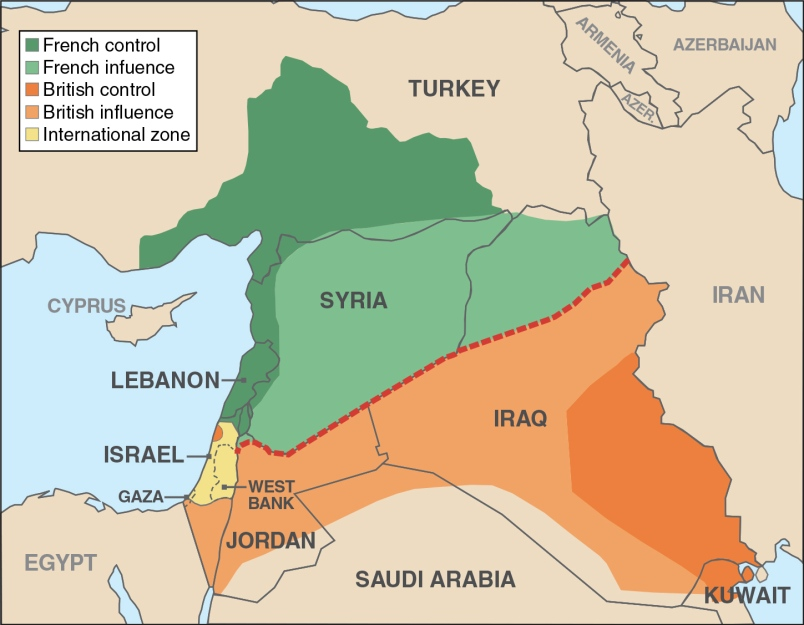
The term “Middle East” appeared in the 19th century as an occidental denomination. Indeed, it comes from the United Kingdom, which put a name on the in-between area from their metropole to India, their main colony. It started with the Suez Canal construction between 1859 and 1869, which facilitated British access to their territories in Asia. It became a strategic challenge at the end of the First World War. As a result of the post-war weakening of the Ottoman Empire. Thanks to the Sykes-Picot Agreement, many territories were put under British, French and Italian control. For example, France got a mandate over Syria and Mount Lebanon. The United Kingdom had one over Egypt, Palestine and Jordan. The controversy about the term “Middle East” The borders, designed by the Western Powers, of those new “nation-states” did not consider the specificities of each lost land’s empire. A similar thing happend in Africa during the Berlin conference (1885), although in a minor way. France and the United Kingdom continued calling this region the “Middle East”, as it corresponded to their Eurocentric arrangement: an area between them and their colonies. Abbas Amanat, an Iranian-born American historian, author, and university professor, explains that it is difficult to define this region, especially since it has no geographical consistency (found the article here). The “Middle East” is a mix of ancient lands with their proper independent identities and new states created by Europeans or Anglo-Americans due to the loss of some empires. While Europe was based on a shared religion, legal principles, and industrial revolutions, the Middle East lacked such unity. Therefore, when Western powers attempted to shape the region in Europe’s image, it could not work. Islam could have operated as a unifying principle, but didn’t since the empires of the 16th century disappeared. Following two World Wars, a Cold War and economic crises, the countries of the “Middle East” felt the urge to unify against Western powers. Especially when the latter used the area as a playing field for war. When Middle Eastern countries created the Organisation of the Petroleum Exporting Countries (OPEC), the European Union got scared that they would get as powerful as it, particularly over oil and gas. Yet, the region isn’t as unified as it was before because the governments, religions and beliefs changed, building some disagreements. What the countries still agree on is the unfair occupation of Palestine, and so the anger toward Israel. Popular movements during the Arab Spring are also linking the civilisations. And we can see the influence of each population on the others.
Yes to Israel, no to Russia. Quo vadis, Eurovision?
This year the Eurovision Song Contest celebrated its 70th anniversary. The winner of this jubilee year is Bulgarian singer Dara. Was it because the audience liked “Bangaranga” so much, or rather because Bulgaria is not Israel? And what about Russia? What is Eurovision? The Eurovision Song Contest is an annual music competition organized by the European Broadcasting Union (EBU), a non-profit association of mostly public, but also some commercial, radio and television stations. Eurovision was created in 1956 to unite Europe (that was still a little bit divided after the 2nd world war) in an amusing, laidback way. Which would be also apolitical – at least that’s what’s proclaimed. The reality is a bit more complicated… 💡: Listen to the most legendary Eurovisions songs Can Eurovision be really apolitical? The final round of the 70th Eurovision took place on Saturday, 16th May, in Vienna. And just like the previous year, it was not without a tense atmosphere around the participation of Israel. Several protests took place in the streets of the Austrian capital because of it. And the Netherlands, Ireland, Iceland, Slovenia and Spain even refused to participate. The final vote was also tense, with Bulgarian Dara and Israeli Noam Bettan facing against each other. In the end Bulgaria won by 173 points. This scenario is weirdly similar to what happened last year when Austria beat Israel. Eurovision as Israeli soft power tool Even though Israel won 4 times throughout the history: in 1978, 1979, 1998 and 2018, in other years, we’ve rarely seen it score top ranking spots. Even in 2024, when the world was still shocked by Hamas’s October attack, Israel came 5th. So how come that in 2025, when we could hear much more critical voices on Israel, it almost won? The answer lies in a recent investigation by The New York Times. According to it the Israeli government spent more than a million dollars on online advertisements promoting Israel’s participation in Eurovision. Diplomats and various Israeli advocacy groups also spread videos on social media calling for repeated voting for the Israeli singer. Because yes, in Eurovision you can vote multiple times. Indecisive people surely appreciate that, however it leaves room for cheating. This year, Eurovision prohibited both of the promotion strategies Israel used. Ironically, it was because last year several European media reported that Israel had paid for an online campaign in an attempt to influence the European audience. We’ve already been there… This benevolence of Eurovision towards Israel might seem surprising compared to its attitude towards Russia. After its 2022 invasion of Ukraine, Russia was quickly banned from the competition. Well, “quickly”; after 14 years of controversial behavior, that began with the invasion of Georgia in 2008, continued with the annexation of Crimea and western parts of Ukraine in 2014. Eurovision has long been benevolent towards Russia in the same way it is now benevolent towards Israel. On the contrary, Eurovision was no longer so benevolent when in 2009 Georgia tried to “get back” at Russia at least musically with the song “We Don’t Wanna Put In”. “EBU told Georgia that the song’s lyrics did not comply with the rules about “lyrics, speeches, gestures of a political or similar nature”, and asked Georgia to either re-write the lyrics of the song, or select another to compete. The day after Georgia withdrew from Eurovision 2009 – which was held in Russia,” says the Eurovision website. The boycott of Russia came only after the political consensus on this country unified across Europe as a result of the 2022 invasion. In the case of Israel, this unification simply hasn’t happened yet. The killings Israel is committing in Gaza are being done in the name of its self-defense. And however disproportionate this self-defense is, some Europeans still see it as justifiable because it didn’t come unprovoked. The large Israeli diaspora in European countries also plays a role. Public broadcasters (= members of the EBU) may fear a possible negative response, or even accusations of anti-Semitism, in case they oppose Israel’s practices or participation. Is a boycott even the effective solution? Speaking of boycotts, we should also ask how effective they are. Because even though Russians cannot compete under their own flag, they still find their way in Eurovision. For example, the songwriter of Dara’s winning “Bangaranga”, Dimitris Kontopoulos, worked on several Russian Eurovision songs together with Philipp Kirkorov, who’s a supporter of Russian leader Vladimir Putin. Eden Golan also had some ties to Russia. Although in 2024 she represented Israel in Eurovision, she spent a significant part of her life living in Russia. Where she was trying for a musical breakthrough by performing at various competitions – including in occupied Crimea. Although this doesn’t immediately make her an active Putin supporter, it certainly doesn’t make her his critic Apoliticality or hypocrisy? As a reaction to the accusations of double standards in Eurovision, its director, Martin Green, said that Russia could “theoretically” be allowed to rejoin the competition if its broadcaster proved they are independent of Putin’s regime. He probably wanted to be diplomatic, but it doesn’t paint a very good picture of Eurovision. While it tries to appease openly aggressive countries by turning a blind eye and offering loopholes, it is merciless towards their victims who want to “defend” themselves with nothing but a mere satire… But was it ever any different? Even the organization of the very first Eurovision in 1956 was actually a political concept: to start a cooperation between European public broadcasters. And this year, politics were not absent either. For example, the song by rapper Satoshi “Viva, Moldova!” is basically a patriotic manifesto calling for the pro-Western integration of Moldova. And the Croatian band Lelek did not abandon the political theme either, singing about the oppression faced by Croatian Catholics in Bosnia and Herzegovina under the rule of the former Ottoman Empire. Eurovision is simply never held in a vacuum. The ambition to be “apolitical” won’t magically erase the existing relations between competing countries.