
The term “Middle East” appeared in the 19th century as an occidental denomination. Indeed, it comes from the United Kingdom, which put a name on the in-between area from their metropole to India, their main colony. It started with the Suez Canal construction between 1859 and 1869, which facilitated British access to their territories in Asia.
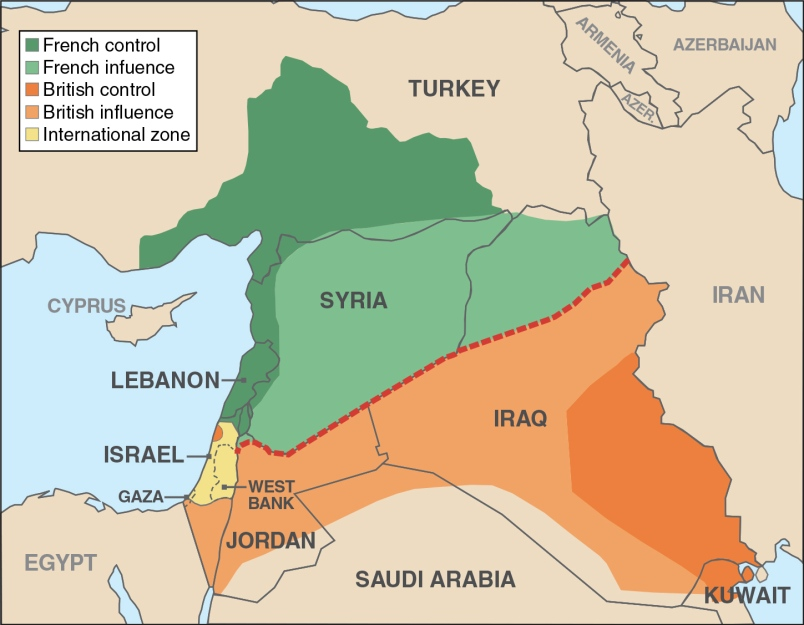
It became a strategic challenge at the end of the First World War. As a result of the post-war weakening of the Ottoman Empire. Thanks to the Sykes-Picot Agreement, many territories were put under British, French and Italian control. For example, France got a mandate over Syria and Mount Lebanon. The United Kingdom had one over Egypt, Palestine and Jordan.
The controversy about the term “Middle East”
The borders, designed by the Western Powers, of those new “nation-states” did not consider the specificities of each lost land’s empire. A similar thing happend in Africa during the Berlin conference (1885), although in a minor way. France and the United Kingdom continued calling this region the “Middle East”, as it corresponded to their Eurocentric arrangement: an area between them and their colonies.
Abbas Amanat, an Iranian-born American historian, author, and university professor, explains that it is difficult to define this region, especially since it has no geographical consistency (found the article here). The “Middle East” is a mix of ancient lands with their proper independent identities and new states created by Europeans or Anglo-Americans due to the loss of some empires. While Europe was based on a shared religion, legal principles, and industrial revolutions, the Middle East lacked such unity. Therefore, when Western powers attempted to shape the region in Europe’s image, it could not work. Islam could have operated as a unifying principle, but didn’t since the empires of the 16th century disappeared.
Following two World Wars, a Cold War and economic crises, the countries of the “Middle East” felt the urge to unify against Western powers. Especially when the latter used the area as a playing field for war. When Middle Eastern countries created the Organisation of the Petroleum Exporting Countries (OPEC), the European Union got scared that they would get as powerful as it, particularly over oil and gas. Yet, the region isn’t as unified as it was before because the governments, religions and beliefs changed, building some disagreements.
What the countries still agree on is the unfair occupation of Palestine, and so the anger toward Israel. Popular movements during the Arab Spring are also linking the civilisations. And we can see the influence of each population on the others.